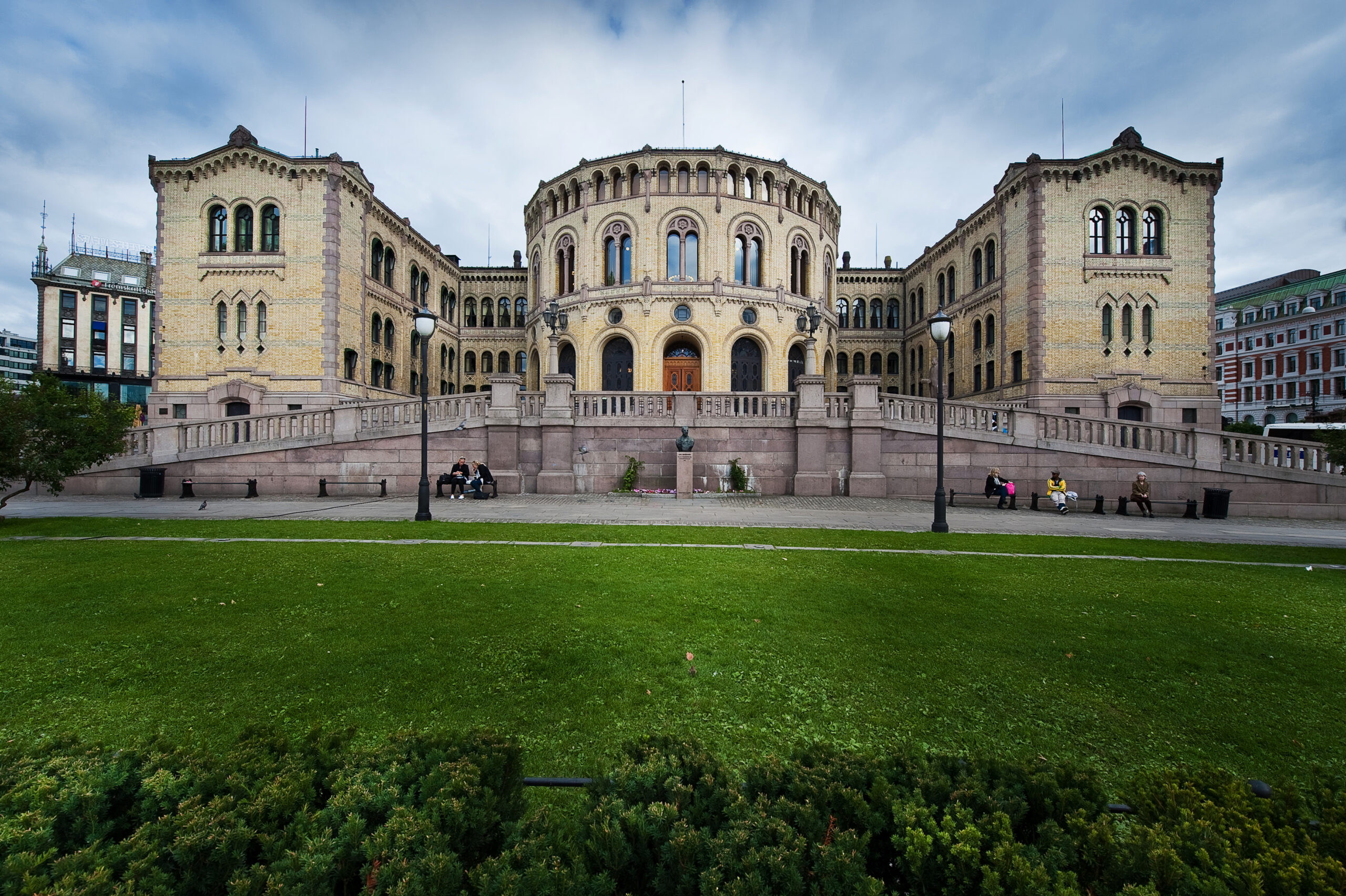
When King Harald V died on Friday morning, Norway did not become a country without a head of state, not even for a second. Crown Prince Haakon, 53, became king in the same instant. There is no waiting period, no confirmation vote and no ceremony that makes it official. The constitution simply moves the crown.
What follows is a sequence of formal steps that unfold over days and months. None of them creates the new king. They record and recognise a change that has already happened.
Advertisement — ad space reserved
Who is told first
Outside the royal household itself, the first people to be informed are the president of the Storting, Masud Gharahkhani, the prime minister, Jonas Gahr Støre, and the Chief Justice of the Supreme Court, Toril Marie Øie. Between them they represent the three branches of the Norwegian state, and the notification is a formality with real constitutional weight: it starts the machinery moving.
The prime minister then calls the government to an extraordinary council of state.
The council of state, the name and the motto
The council of state is the new king’s first act in office. He formally informs the government of his father’s death, and he announces two things that are entirely his own choice.
The first is the name he will reign under. It is not automatic. A monarch may take a name other than the one he has used all his life, and there are recent examples elsewhere: the British king known as George VI had gone by Albert, and his brother David reigned as Edward VIII. Most Norwegian observers expect Haakon VIII, and the royal biographer Tor Bomann-Larsen has pointed out that King Olav said it was Haakon that would be used. Until the announcement is made, he is referred to in public simply as His Majesty The King.
The second is his motto, a short phrase meant to express the values guiding his work. The last three Norwegian monarchs — Haakon VII, Olav V and Harald V — all chose the same one, which translates as “All for Norway”. Whether the new king keeps it is one of the more closely watched questions of the coming days.
Advertisement — ad space reserved
The oath before parliament
Article 9 of the Norwegian constitution requires the king to swear an oath promising to govern the kingdom in accordance with its constitution and laws, calling on God as witness. The oath is meant to be sworn out loud before the Storting. If parliament cannot be assembled at the time of the succession, it is sworn in writing in the council of state and then repeated aloud the first time the chamber sits.
The royal historian Trond Norén Isaksen has noted that the chamber itself has to be prepared first, so even where parliament is available the oral oath can take a few days.
No coronation — but possibly a consecration
Norway does not crown its monarchs. The 1814 constitution required a coronation in Nidaros Cathedral, but parliament struck that clause out in 1908, taking the view that it was undemocratic and out of date. So when Haakon VII died in 1957 there was no legal basis for a coronation at all.
Olav V invented a replacement. He asked to be consecrated in Nidaros Cathedral — to receive a blessing on his work as king rather than a crown — and Harald and Sonja repeated it in June 1991. It is entirely optional. Haakon has previously indicated he would want it. Isaksen has suggested that if it goes ahead, a consecration journey through southern Norway would follow around midsummer, with a corresponding journey through the north the summer after.
The new titles
Mette-Marit becomes queen, exactly as Sonja did in 1991 when Harald succeeded Olav. Her official programme will have to be shaped around her health: she received a lung transplant at Rikshospitalet in June after living with pulmonary fibrosis since 2018.
Advertisement — ad space reserved
Princess Ingrid Alexandra, 22, is now first in line to the throne. The constitution leaves it to the king to determine the titles of those with a right of succession, so the formal title of crown princess has to be confirmed by the palace rather than being assumed automatically.
Her position carries a detail without a modern precedent. This is the first time in recent Norwegian history that the person standing second in the line of succession is already an adult at the moment of a succession. As an heir of age she may sit in the council of state alongside the monarch, though without a vote and without responsibility for the decisions taken there, and she is required to swear an oath in writing to the Storting.
A long quiet period
The government has declared a national mourning period running from the day of death to the day of the funeral. Separately, the court is expected to observe a considerably longer period of official mourning, during which most royal engagements will be cancelled or postponed.
That matters more than it might sound. The Norwegian monarchy is a working institution with a dense calendar of visits, openings and state functions, and a court in mourning is a court that largely stops appearing in public. It arrives at the end of a difficult stretch for the family, covered in more detail here: A Decade of Scandal and Illness at the Norwegian Court.
Sources
The Constitution of Norway, Article 9; the Norwegian royal house (kongehuset.no); NRK; VG; Nettavisen; Rett24; Store norske leksikon.
Leave a Reply