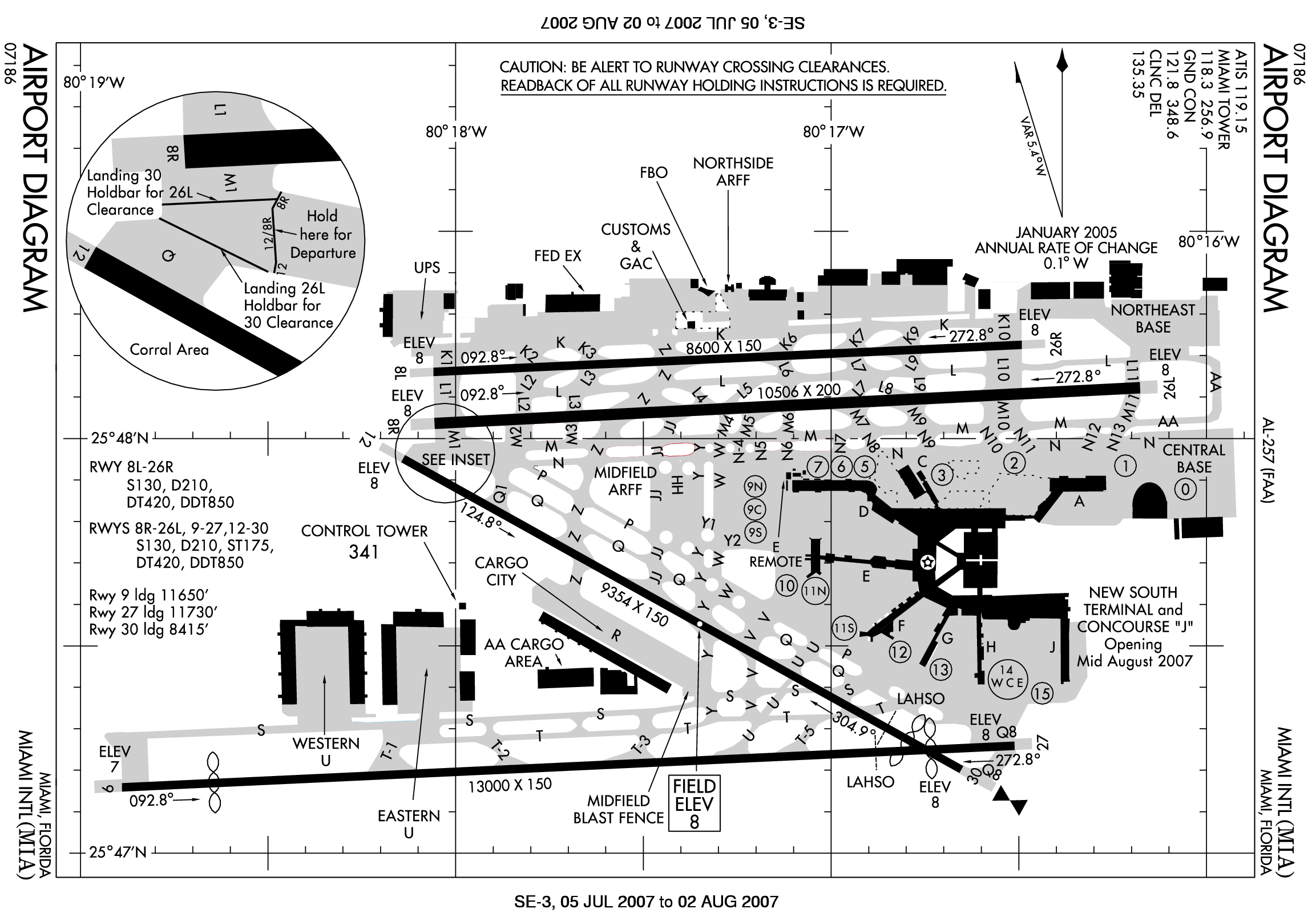
After Sunday’s crash at Miami International Airport, in which a Boeing 767 freighter left Runway 30 and struck vehicles on a road beyond the perimeter, the obvious question is how an aircraft that lands normally ends up off the end of the pavement.
Nothing here is about that accident, whose cause is unknown and under investigation by the National Transportation Safety Board. This is what is generally understood about the category of event, which aviation safety bodies call a runway excursion.
Advertisement — ad space reserved
Landing is a stopping problem
A large aircraft touches down at somewhere between 130 and 160 miles per hour and has a fixed distance in which to stop. The calculation done before every landing compares the distance required with the distance available, and the required figure depends on weight, wind, temperature, altitude, runway surface condition and how much of the runway is used before the wheels are actually down.
Three systems do the stopping. Wheel brakes do most of it. Spoilers — panels that rise from the wing on touchdown — dump the lift so the aircraft’s weight presses onto the wheels, which is what makes the brakes effective. Thrust reversers redirect engine thrust forward. If any of the three underperforms, the others must do more, and stopping distance grows.
The recurring contributors
Investigation bodies including the NTSB, the European Union Aviation Safety Agency and the Flight Safety Foundation have examined overrun accidents for decades. A consistent set of factors appears.
Water on the runway. A wet runway can reduce braking sharply, and standing water can cause hydroplaning, where a layer of water lifts the tyre off the surface and braking effectively stops working. In the 2019 overrun of a Boeing 737 at Naval Air Station Jacksonville, the NTSB attributed the accident to hydroplaning caused by heavy rain on an ungrooved runway, and concluded the aircraft could not have stopped even had the landing been flown perfectly. Grooving cut into the surface helps water drain, which is why it is used on many runways.
Landing long or fast. Touching down beyond the intended point consumes runway that the stopping calculation assumed would be available. Excess approach speed has a similar effect and compounds it, since kinetic energy rises with the square of speed.
Tailwind. A tailwind increases groundspeed at touchdown for the same airspeed, which lengthens the roll.
Equipment. Brake, spoiler or reverser faults are less common than the environmental and handling factors, but they occur.
The decision not to go around. A crew can abandon a landing and fly the approach again. Safety researchers have written extensively about why this option is used less than the data suggests it should be, and the explanations offered — schedule pressure, the sense that the landing is nearly complete, reluctance to declare a failed approach — are contested in their relative weight but broadly agreed to exist.
Advertisement — ad space reserved
What is at the end of the runway
Because overruns cannot be eliminated, airport design assumes they will happen. Runways are supposed to have a runway end safety area, a graded strip beyond the paved surface intended to reduce damage to an aircraft that goes off.
Where there is not enough land — a common problem at airports built before modern standards and since surrounded by city — one solution is an engineered materials arresting system, a bed of lightweight crushable concrete blocks at the runway end. The wheels sink into it and the aircraft is brought to a stop over a short distance. These beds have stopped aircraft at several US airports.
The limitation is straightforward: they work within a design range of speeds and weights, they must be replaced after use, and they are not installed everywhere. The trade-off is cost and space against a rare but severe event, and airport authorities and regulators do not always agree about where the line falls.
Why single-cause explanations are usually wrong
The pattern in overrun reports is accumulation rather than failure. A runway is wet, the wind has a tailwind component, the aircraft is near maximum landing weight, the touchdown is slightly long, and reverse thrust is selected a second late. Any one of those is survivable with margin to spare. Together they can exceed the distance available.
This is why investigators are slow, and why the confident explanations that circulate in the days after a crash are worth ignoring. Investigators will have the flight data recorder, the cockpit voice recorder, the runway condition reports, the weather record and the aircraft’s maintenance history. Almost nobody commenting publicly in the first week has any of it.
Advertisement — ad space reserved
Sources
- National Transportation Safety Board final report on Miami Air International Flight 293, Naval Air Station Jacksonville, 3 May 2019
- Federal Aviation Administration guidance on runway end safety areas and engineered materials arresting systems
- Flight Safety Foundation published work on runway excursion risk and go-around decision making
- European Union Aviation Safety Agency material on runway safety
- Our report on the Miami accident, 7 September 2026
Leave a Reply