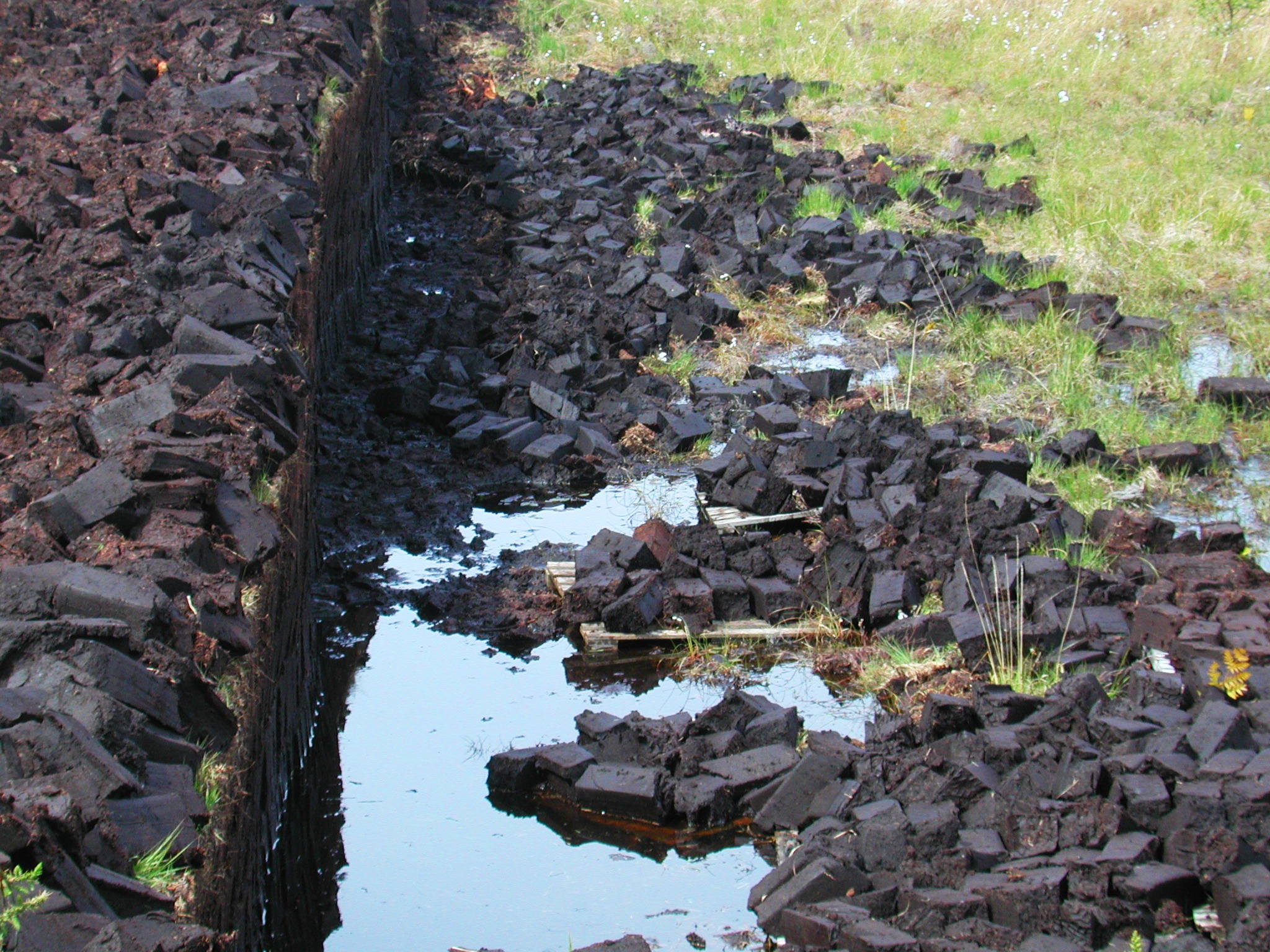
When fires burn across Indonesia’s peatlands, the reporting usually calls them wildfires. The word is not wrong, but it hides the thing that makes them so difficult to stop. A peat fire is not really a fire in a forest. It is a fire in the ground.
What peat is
Peat is partly decomposed plant material that has built up over thousands of years in waterlogged ground. Normally, dead vegetation rots away and returns its carbon to the atmosphere. In a bog or a swamp forest, the water excludes oxygen, decomposition nearly stops, and the plant matter simply accumulates — layer on layer, at something like a millimetre a year.
The result, in parts of Sumatra and Borneo, is peat several metres deep. It is essentially a very large, very old store of carbon, held in place by being wet.
What drainage does
Peat swamp is poor land for plantations, so it gets drained: canals are cut, the water table drops, and the upper peat dries out. Dried peat is fuel. It is, in effect, a coal seam in an early stage of formation.
This is why fire behaviour on drained peatland differs so sharply from fire in an undrained one, and why the question of who lit a particular fire is less important than it looks. Ignition sources are everywhere in an inhabited landscape. What determines whether an ignition becomes a months-long emergency is whether the ground beneath it is wet.
From Plain Sight News
Smouldering, not burning
A forest fire is flaming combustion: hot, fast, visible, consuming leaves and branches in the air. A peat fire is smouldering combustion: cooler, slow, largely flameless, and taking place below the surface.
Smouldering has three properties that make it a nightmare to fight.
- It travels underground. The burning front moves through the peat layer, sometimes metres below the surface, and can pass beneath firebreaks, roads and rivers before emerging somewhere else entirely.
- It needs very little oxygen. A smouldering front can sustain itself in conditions that would put out a flame, which is why it survives rain showers that would end a surface fire.
- It is hard to see. Satellites detect hot spots by thermal signature, and a subsurface smoulder is a much weaker signal than an open flame. Official hot spot counts therefore tend to understate what is actually burning.
This is also why aerial water-bombing, which is effective against flaming vegetation, does comparatively little against peat. Water dropped on the surface runs off or wets only the top layer. Extinguishing a peat fire properly requires saturating the peat itself, which means enormous volumes of water delivered into the ground, or waiting for the water table to rise on its own.
The smoke is different too
Because smouldering is incomplete combustion at relatively low temperatures, it produces far more smoke per unit of fuel than flaming fire, and smoke richer in fine particulate matter and carbon monoxide. That is the physical reason peat haze is so much worse for health than the smoke from an equivalent area of burning grass or scrub.
It also explains the persistence. A forest fire’s smoke stops when the fire does. Peat smoke can continue for weeks after the visible flames are gone, which is how a city ends up under haze for a month at a time.
From Plain Sight News
The carbon question
Peatlands cover a small share of the world’s land surface but hold a very large share of its soil carbon — researchers commonly estimate that they store more carbon than all the world’s forests combined, despite occupying a few per cent of the land area. The major deposits are in the northern boreal zone, in Southeast Asia, and in the Congo Basin, where a vast peatland complex was mapped only in the past decade.
Burning peat releases carbon that took millennia to accumulate, in a matter of weeks. That is why Indonesian fire seasons have in bad years pushed the country’s emissions temporarily above those of much larger industrial economies, and why peatland is treated in climate policy as a category of its own rather than as a subset of forest.
What actually stops it
The intervention that fire scientists and restoration agencies point to is rewetting: blocking drainage canals so the water table rises back towards the surface, and letting the peat return to the waterlogged state that made it fireproof for thousands of years.
Indonesia has run large rewetting programmes, and independent assessments of them have been mixed — some blocked canals hold, others fail or are reopened, and rewetted land is less productive for the crops it was drained for, which creates a standing incentive to drain it again. The argument is not really about the science of water tables. It is about who bears the cost of leaving land wet.
Until that is settled, the annual sequence holds: dry season, ignition, smoulder, haze, and the wait for rain.
From Plain Sight News
Leave a Reply