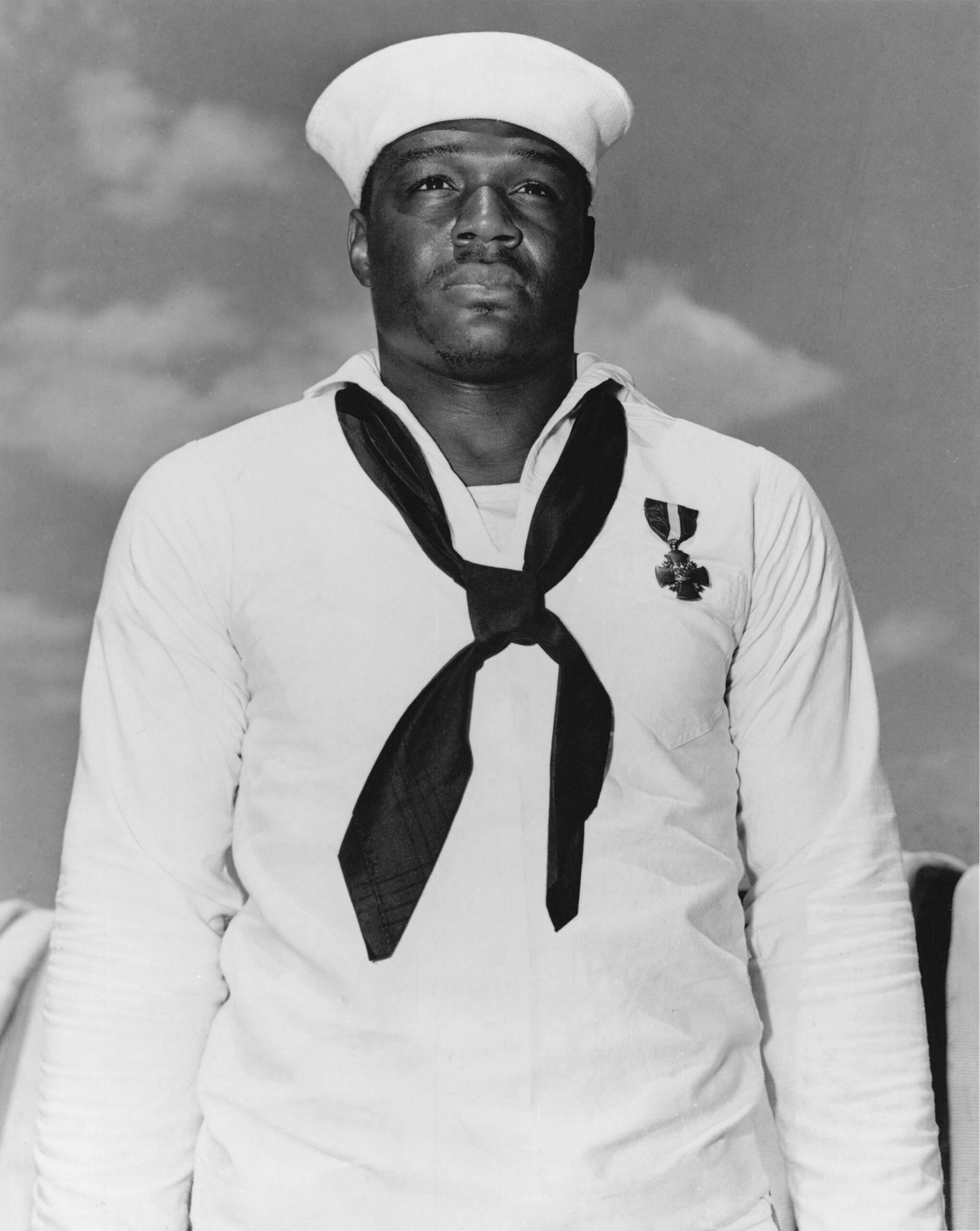
The US Navy is considering renaming an aircraft carrier after President Trump when construction is finished, according to CNN, which first reported the plan. The ship is currently named the USS Doris Miller.
Advertisement — ad space reserved
Who Doris Miller was
Doris Miller was a mess attendant aboard the battleship USS West Virginia at Pearl Harbor on 7 December 1941. Black sailors in that Navy were confined to service roles and were not trained on weapons.
When the attack began, Miller helped carry wounded men to safety, including his mortally injured captain, then manned an unattended anti-aircraft gun and fired it until he ran out of ammunition and was ordered to abandon ship. He received the Navy Cross, the service’s second-highest decoration for valour, presented by Admiral Chester Nimitz. He was killed in 1943 when the escort carrier he was serving on was torpedoed in the Pacific.
The carrier bearing his name was announced in 2020. It was the first time a carrier had been named for an enlisted sailor, and the first for an African American.
How Navy ships get their names
The authority sits with the Secretary of the Navy, in practice with heavy presidential input, and it is governed by convention rather than statute. Conventions have shifted repeatedly: carriers were once named for battles, then for presidents, and more recently, occasionally, for individuals honoured for other reasons.
Renaming a ship already named is rarer than choosing a name in the first place, and among sailors it carries a superstition against it. But it is not unprecedented, and there is no legal barrier to doing it.
Advertisement — ad space reserved
The case each way
Those in favour point out that naming carriers after presidents is the dominant American tradition — the fleet includes ships named for Eisenhower, Reagan, both Bushes, Truman and Ford — and that a sitting president is not an unusual choice by the standards of that tradition. On this argument, honouring Miller could be done with another vessel or shore facility, and the objection is sentiment rather than principle.
Those against make two distinct points, and it is worth separating them. The first is about the individual: Miller’s name was chosen precisely because the Navy wanted to mark a sailor who acted with conspicuous courage inside a service that had refused to train him, and removing it undoes a specific act of recognition. The second is about presidents naming things after themselves while in office, which critics say breaks a norm regardless of who does it — presidential names have generally been applied to ships after the president in question left office, and usually after death.
Veterans’ organisations and members of Congress from both parties have objected to previous renaming proposals of this kind. Whether that opposition materialises here, and whether it has any effect, is the thing to watch.
The context it lands in
The report arrived in the same week as the Justice Department’s suggestion that the Kennedy Center could be demolished if the administration cannot add the president’s name to it, and amid a broader dispute over the naming of federal property. Taken alone, a carrier name is a small matter. The pattern is what the objections are really about.
The Navy has not confirmed a decision, and CNN reported the plan as under consideration rather than settled. The ship is still under construction.
Advertisement — ad space reserved
Sources
CNN; Democracy Now!; US Navy historical records on Doris Miller and the Navy Cross; Naval History and Heritage Command materials on ship naming conventions.
Leave a Reply