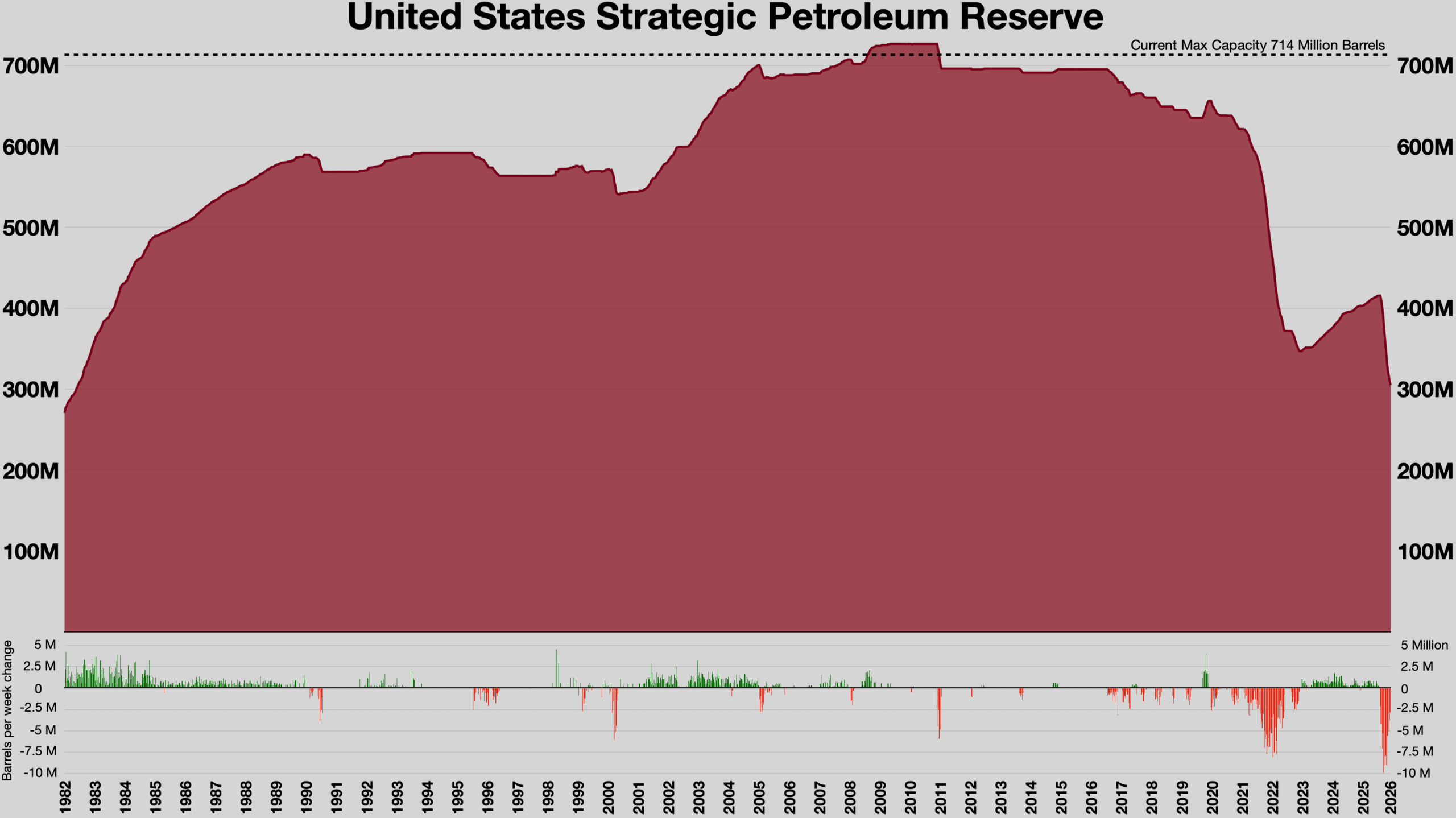
Crude oil held in the US Strategic Petroleum Reserve has fallen below 300 million barrels, the lowest level since 1983. The drawdown is happening while the Strait of Hormuz remains largely unusable and while the US Energy Information Administration has raised its estimate of how much Middle East production will stay shut in.
Advertisement — ad space reserved
What the reserve actually is
The Strategic Petroleum Reserve is crude oil stored in underground salt caverns along the Gulf Coast of the United States. It was created after the oil shock of the 1970s, and its purpose is narrow: to cover a physical interruption of supply, not to manage the price of petrol.
Two things about it are commonly misunderstood. It holds crude, not fuel — releasing it does nothing unless refineries have the capacity to process it and pipelines to move it. And it cannot be emptied quickly: the caverns have a maximum daily withdrawal rate, so the useful question is not how many barrels are in there but how many can come out per day, and for how long.
Why the level matters now
A reserve is insurance, and insurance is judged by whether it covers the event you are actually facing. The event being faced is a chokepoint closure that has already run for months.
The EIA’s August outlook increased its estimate of shut-in Middle East crude production because of continued severe constraints on Hormuz transits, and it expects disruption of roughly 0.6 million barrels a day to persist through the end of next year even after most regional production returns to pre-conflict levels in early 2027. It forecasts Brent averaging around $85 a barrel in the third quarter.
Set those two facts side by side and the shape of the problem is clear. The reserve is at a four-decade low at the same moment as the disruption it exists for has become long rather than sharp — and a stockpile is well suited to a short shock and poorly suited to a chronic shortfall.
Advertisement — ad space reserved
The argument about refilling
This is where informed people disagree, and both positions are worth stating properly.
One view holds that a reserve at these levels is a strategic vulnerability, that the United States should have been buying when prices were low, and that a stockpile which is politically easy to draw down and politically hard to refill will always ratchet toward empty.
The competing view is that the reserve was designed for a country that imported most of its oil, and that this is no longer the situation. US crude production is high and natural gas output is on track for a record this year. On that reading, domestic production is itself a buffer, and holding hundreds of millions of barrels underground is an expensive answer to a problem that has changed shape.
Both arguments have a weak point. The first underrates how much of the risk has shifted. The second underrates the fact that oil is priced globally: a disruption in the Gulf raises the price Americans pay whether or not a single barrel they burn came from there.
The constraint nobody stockpiles for
There is a second energy story running underneath this one, and it does not involve oil at all. US electricity demand is heading for record highs, driven substantially by data centre construction, and analysts increasingly describe transmission rather than generation as the binding constraint — aging infrastructure, limited line capacity, and shortages of equipment such as transformers.
Electricity prices have risen faster than general inflation over the past year. There is no strategic reserve for electricity; it has to be generated the moment it is used. The oil headline is the one that gets written, but the constraint that is harder to fix is the wire.
Sources
- EIA — August 2026 Short-Term Energy Outlook, Hormuz disruption assumptions and Brent forecast
- CNBC — SPR falls below 300 million barrels, lowest since 1983
- OilPrice — record electricity demand and transmission constraints
Advertisement — ad space reserved
Leave a Reply