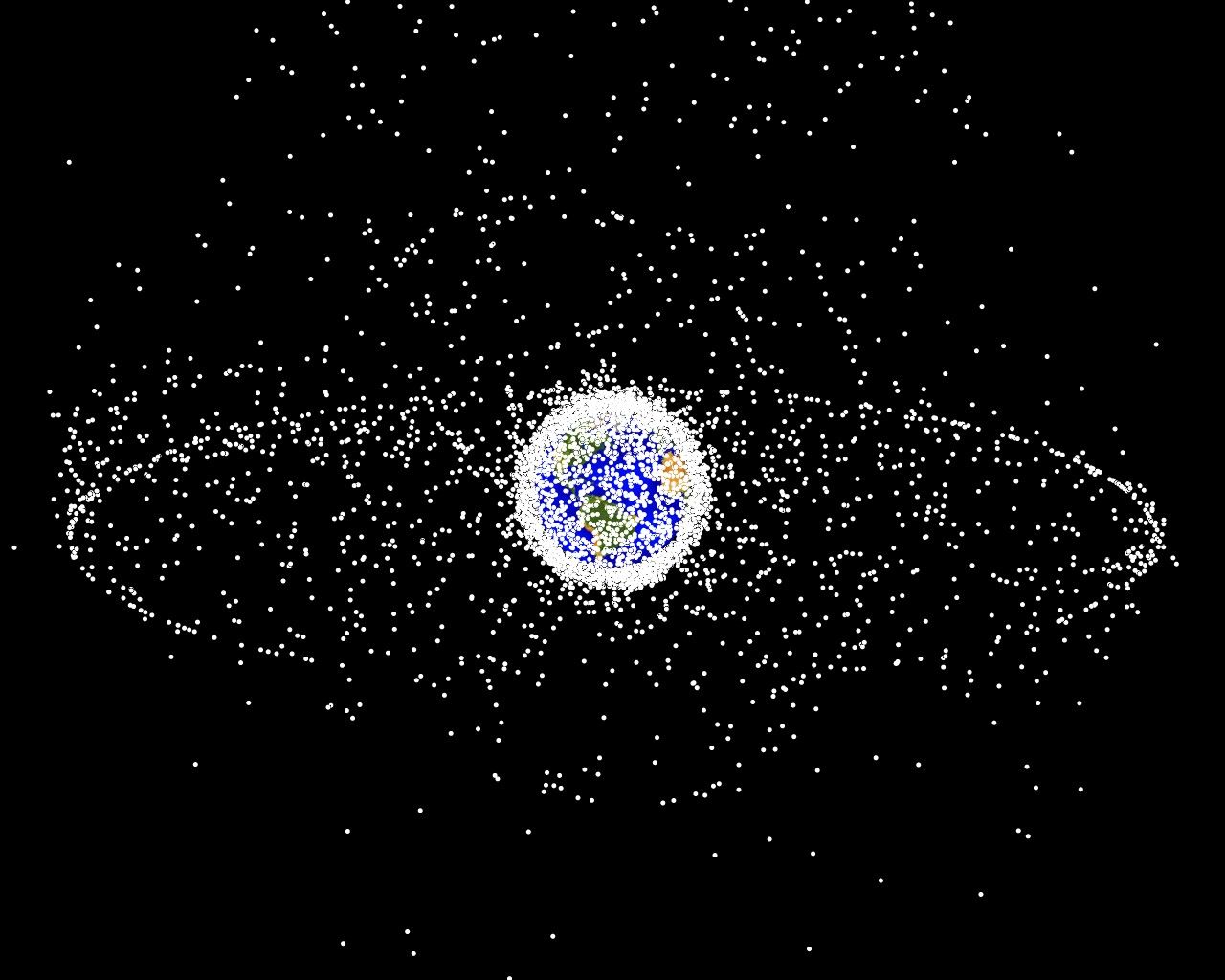
Research reported by the journal Science warns that the satellite megaconstellations now being planned could generate runaway space debris — a cascade in which collisions produce fragments that cause further collisions.
The concern is not that a satellite might be lost. It is that a region of space could become unusable for decades.
Advertisement — ad space reserved
What a megaconstellation is
Traditional satellite services used a small number of large satellites parked high above the Earth. A megaconstellation does the opposite: thousands of small satellites in low orbit, working as a network. Because they are closer, signals travel faster — which is why this design is being used to deliver internet access to places cables do not reach.
The benefits are real. Remote communities, ships, aircraft and disaster zones get connectivity that was previously impossible or unaffordable.
The difficulty is arithmetic. Low orbit is a shared, finite volume, and several operators are planning constellations of thousands of satellites each.
Why fragments are the danger
Objects in low orbit travel at several kilometres per second. At that speed a fragment the size of a bolt carries enough energy to destroy a spacecraft. Shielding helps against the smallest particles and is useless against anything larger.
The feared sequence, first described decades ago and known as the Kessler syndrome, runs like this. One collision creates thousands of fragments. Those fragments raise the chance of further collisions. Each of those produces more fragments. Past a certain density, the process continues on its own, whether or not anyone launches anything else.
The result would not be a dramatic event. It would be a slow closing of a useful orbit.
Advertisement — ad space reserved
What is already up there
Low orbit is not empty, and it has not been for a long time. Alongside working satellites it holds spent rocket stages, discarded hardware, flakes of paint and fragments from past collisions and deliberate weapons tests.
Agencies track tens of thousands of objects large enough to be followed by radar, roughly the size of a fist or bigger. The number of smaller pieces — still capable of destroying a spacecraft — is estimated in the hundreds of millions, and estimates are all they can be, because those fragments cannot be seen from the ground.
Two events did a great deal of the damage. In 2007 a country destroyed one of its own weather satellites in a weapons test, producing thousands of trackable fragments. In 2009 a working communications satellite collided with a defunct one, producing thousands more. Both sets of debris are still in orbit and will remain so for many years.
The concern about megaconstellations is not that they would start something new. It is that they would add a great deal of traffic to a space that already contains the wreckage of past mistakes.
Why the debris does not simply fall
People often assume orbital junk eventually burns up on its own. It does — but the timescale depends entirely on altitude, and the difference is enormous.
A few hundred kilometres up, traces of atmosphere still create drag. Objects there gradually lose speed and re-enter within years, which is why that band is regarded as relatively self-cleaning. Higher up, the atmosphere thins to almost nothing. Debris at those altitudes can stay in orbit for centuries.
This is why the phrase “runaway” carries weight. A cascade in a low band would be serious and would eventually clear. A cascade higher up would effectively be permanent on any human timescale — not a problem to be solved but a region to be written off.
Advertisement — ad space reserved
Why it is hard to prevent
Operators do take precautions. Satellites carry thrusters to dodge tracked objects, and modern designs are meant to be deorbited at the end of their working life so they burn up in the atmosphere.
Three problems remain. Not every object is tracked — small fragments are effectively invisible. Deorbiting relies on a satellite still working; one that fails early stays up. And there is no single authority that can cap how many satellites are launched, because orbit is not owned by anyone.
This is a familiar shape of problem. Each operator’s launches are individually reasonable. The combined effect is what causes harm, and no one participant has an incentive to stop first.
Why it would matter on the ground
Satellites in low orbit are not a luxury. They carry weather observation, disaster monitoring, climate measurement, navigation support, maritime tracking and communications for places with no other option.
A degraded orbit would not switch those off overnight. It would make replacing them slower, riskier and more expensive — and the people who would lose the service first are the ones with no alternative.
The warning here is about a threshold that is easy to cross and very hard to step back from. Debris does not clear itself on any human timescale.
Source: Science (AAAS), 7 August 2026.
Advertisement — ad space reserved
Leave a Reply