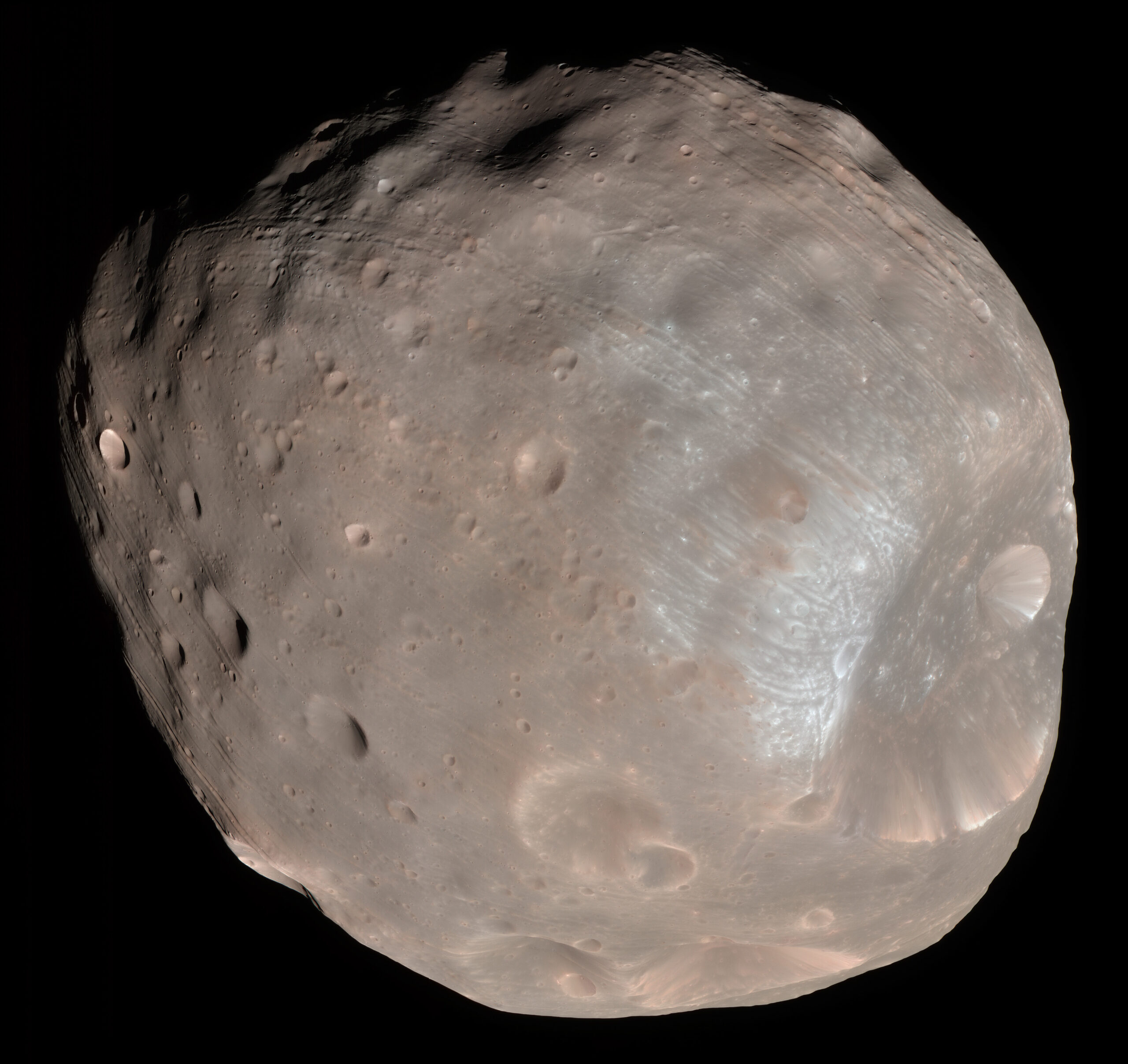
NASA’s Perseverance rover has photographed something no camera on the surface of Mars had captured before: Earth disappearing behind Phobos, the larger of the two Martian moons.
Seen from nearly 195 million miles away, our planet appears as a single point of light — no continents, no blue, nothing but a dot bright enough to stand out against the dark. Then the dot goes behind a lumpy object roughly 22 kilometres across, and for a short while it is not there at all.
Advertisement — ad space reserved
What an occultation is
When one body passes in front of another from a particular viewpoint, astronomers call it an occultation. It is the same geometry as a solar eclipse, with the roles reassigned: here the moon is Phobos, the observer is a rover in Jezero Crater, and the thing being hidden is us.
Phobos is an unusual moon. It is not spherical — it looks more like a battered potato — and it orbits closer to its planet than any other moon in the solar system, circling Mars roughly three times a Martian day. From the surface it moves visibly fast, rising in the west and setting in the east.
Rovers have watched Phobos cross the face of the Sun before, producing the ragged partial eclipses that Mars offers instead of the neat totality we get on Earth. Catching it crossing in front of Earth requires the alignment to hold between three bodies in different orbits, with a camera pointed correctly at the right moment.
Why the science is real, not just the picture
Observations of this kind are used to refine what is known about Phobos’s orbit. The moon is slowly spiralling inwards, and its path is measured precisely by timing when it passes in front of known objects. Those measurements feed into models of Martian tides and of the moon’s internal structure — and into the long-running argument about whether Phobos is a captured asteroid or debris from an ancient impact on Mars.
Its eventual fate is not in dispute: within tens of millions of years, tidal forces will either break it apart into a ring or bring it down onto the surface.
Advertisement — ad space reserved
The other thing the image does
There is a small tradition of photographs like this. Voyager 1’s pale blue dot in 1990, taken from beyond Neptune, and Cassini’s images of Earth from Saturn belong to the same family: pictures whose scientific content is modest and whose effect is entirely a matter of perspective.
Every person alive is inside that dot. A lump of rock 22 kilometres wide, orbiting another planet, is large enough to hide all of it. That is not a scientific finding, but it is worth a moment.
Sources
NASA Jet Propulsion Laboratory imagery from the Perseverance rover, reported 13 August 2026 via ScienceDaily; background on Phobos from published planetary science literature.
Advertisement — ad space reserved
Leave a Reply