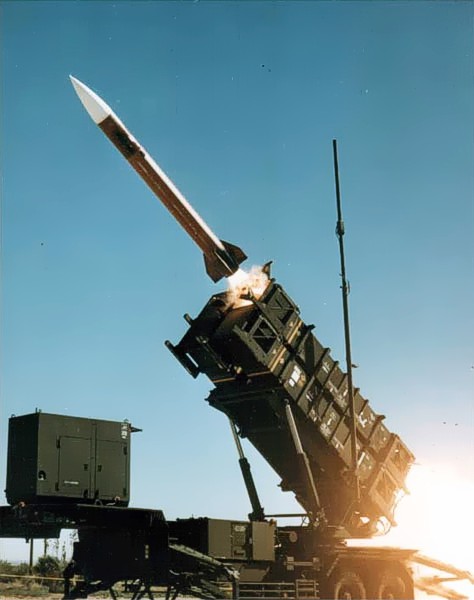
The Pentagon is facing what the Associated Press reported this week as a “beyond critical” shortage of Patriot missile interceptors in Europe, having spent most of its stock defending American bases and Israel against Iranian drones and missiles over six months of war.
Separately, the Washington Post reported that the CIA director’s unannounced trip to Moscow earlier in the week followed fresh American intelligence indicating that the Kremlin now regards the United States as weakened by the Iran war.
Those two reports are about the same problem seen from two ends.
Advertisement — ad space reserved
Why interceptors run out
Air defence has an arithmetic that favours the attacker, and it is worth setting out plainly.
A Patriot interceptor costs in the region of several million dollars. Many of the drones fired at defended sites cost a few tens of thousands, some far less. Doctrine typically calls for firing two interceptors at a single incoming ballistic missile to raise the probability of a kill. So a defender can spend millions to stop something that cost the attacker a fraction of that, and does so every night the attacks continue.
The second constraint is manufacturing. Interceptor production lines are specialised, the components include items with long lead times, and output is measured in hundreds per year rather than thousands. Deciding to build more does not produce more for a considerable time. That is why stock levels, once drawn down, stay down.
What a shortage in Europe actually means
Interceptors held in Europe are not decorative. They cover American bases, allied airspace and, in recent years, transfers to Ukraine. Drawing that inventory down to defend the Middle East is a decision to accept risk in one theatre in order to reduce it in another.
The consequence is not that Europe becomes undefended. It is that the margin narrows: fewer systems available to move, less depth if something happens somewhere unexpected, and harder choices about which ally gets resupplied.
Advertisement — ad space reserved
The Moscow connection
This is where the two reports meet. If American intelligence assesses that Moscow believes the United States has been materially weakened, the interceptor shortage is one of the things that assessment would be built on. Stockpiles are among the most legible measures of military capacity available to a rival: they can be estimated from production rates and expenditure without needing a source inside the building.
What follows from such a belief is contested among analysts. One view is that a rival who thinks an adversary is overstretched becomes more willing to test it, and that the risk period is now. The other is that this kind of assessment mainly changes negotiating behaviour rather than military behaviour — you press harder at the table, not on the ground.
A senior intelligence official travelling quietly to Moscow is consistent with either reading, which is the difficulty with drawing conclusions from a trip whose agenda has not been published.
The part that outlasts this war
Defence economists have been making a version of this argument for years, well before the current conflict: that Western militaries are configured for short, intense operations and hold inventories to match, while the wars they actually end up fighting are long and consume munitions at industrial rates.
The counter-argument is that holding vast stockpiles of expensive, ageing interceptors is itself wasteful, and that the real answer is cheaper defences — guns, lasers, electronic jamming — matched to the cost of what is being shot down. Several programmes along those lines exist. None of them is available at scale this year.
Related: Iran’s conditions for reopening the Strait of Hormuz.
Advertisement — ad space reserved
Sources
Associated Press; The Washington Post; published analyses of interceptor production rates and air-defence cost exchange ratios.
Leave a Reply