Iran and Oman have proposed setting up a temporary shipping corridor through the Strait of Hormuz and a joint project to clear the waterway of mines — the clearest movement yet towards restoring commercial navigation through the strait. Within hours, Tehran said the strait would not actually reopen until the United States ends the war.
Both statements are true at once, and the gap between them is the story.
What was agreed, and what was not
Oman’s foreign minister, Sayyid Badr bin Hamad Albusaidi, travelled to Tehran on Tuesday for talks with his Iranian counterpart, Abbas Araghchi. A joint statement afterwards said the two had discussed a phased framework offering what they called a practical and implementable basis for moving forward, while preserving the sovereignty and sovereign rights of both countries.
The framework has two immediate components: a joint temporary navigational corridor through the strait, and an agreement to implement a joint mine-clearing project. Technical negotiations would continue on the harder questions — a permanent corridor, who administers the strait in future, and mechanisms for information-sharing, traffic management and navigational and security services. Both sides said other Gulf coastal states should be brought into the discussion.
Albusaidi said he hoped a corridor and practical arrangements to restore safe navigation could be announced soon, and described the talks as constructive.
What was not agreed is an opening date. On Wednesday, Iran said the strait remains closed and set out its conditions: an end to the US naval blockade, the lifting of oil sanctions, and the unfreezing of Iranian assets held abroad.
From Plain Sight News
Why Oman is the country in the room
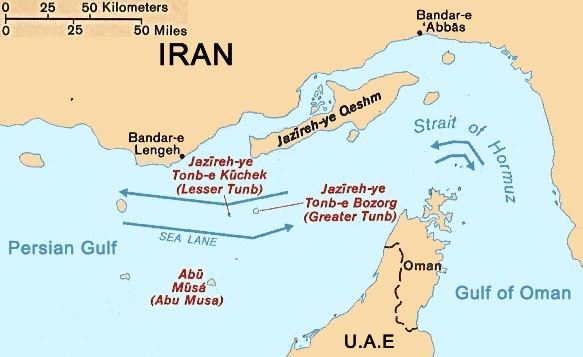
Oman’s position is geographic before it is diplomatic. The shipping lanes through the Strait of Hormuz run through territorial waters belonging to Oman and Iran, with the inbound and outbound lanes passing either side of the Musandam peninsula — Omani territory separated from the rest of the country by the United Arab Emirates.
That makes Oman a necessary party to any arrangement rather than a volunteer mediator. It also has a long-standing role as the Gulf state that keeps channels open to Tehran, which is why the June memorandum of understanding between Washington and Tehran assigned the question of transit regulation to this track in the first place.
It has not been a comfortable position. Earlier this month President Trump publicly threatened to bomb Oman — a US partner — when asked about its talks with Iran.
What the shipping data shows
Oil moving through the strait was running at about 5 million barrels a day on Monday, according to provisional figures from the tracking firm Vortexa. Before the war it carried more than 20 million barrels a day — roughly one of every five barrels consumed worldwide.
So the strait is neither open nor entirely shut. A quarter of the previous volume is still moving, at higher insurance cost and with longer waits, while the rest has been rerouted, delayed or simply not produced.
From Plain Sight News
Why a technical deal can outrun a political one
There is a pattern here that recurs in conflicts over waterways. Clearing mines and agreeing a traffic lane are engineering problems with technical answers, and they can be negotiated by people whose governments are not otherwise speaking. Deciding who controls a strait is a sovereignty question, and it usually cannot.
The framework announced this week deliberately separates the two. It proposes to do the solvable part now — a temporary corridor, mines removed — and leave permanent administration to later technical talks. That is a familiar structure, and it can work. It can also stall indefinitely, with the temporary arrangement quietly becoming the permanent one because nobody can agree on a replacement.
Iran’s statement on Wednesday indicates it does not intend to let the technical track run ahead of its political demands. Whether that is a negotiating position or a fixed condition is not something that can be determined from the outside.
What to watch
Three things. Whether the mine-clearing project actually begins, and who does the work. Whether daily transit volumes move from 5 million barrels towards their pre-war level. And whether other Gulf states join the talks, as both sides said they should — because a corridor agreed by two countries and ignored by insurers and shipowners changes nothing on the water.
From Plain Sight News
Sources
- AFP via Arab News, “Iran says Hormuz still closed despite transit corridor talks”, 26 August 2026
- Al Jazeera, on the proposed framework, 25 August 2026
- CNBC, with Albusaidi’s comments and the contradiction over mines, 25 August 2026
- Oman News Agency via Muscat Daily, the joint statement, 25 August 2026
Leave a Reply