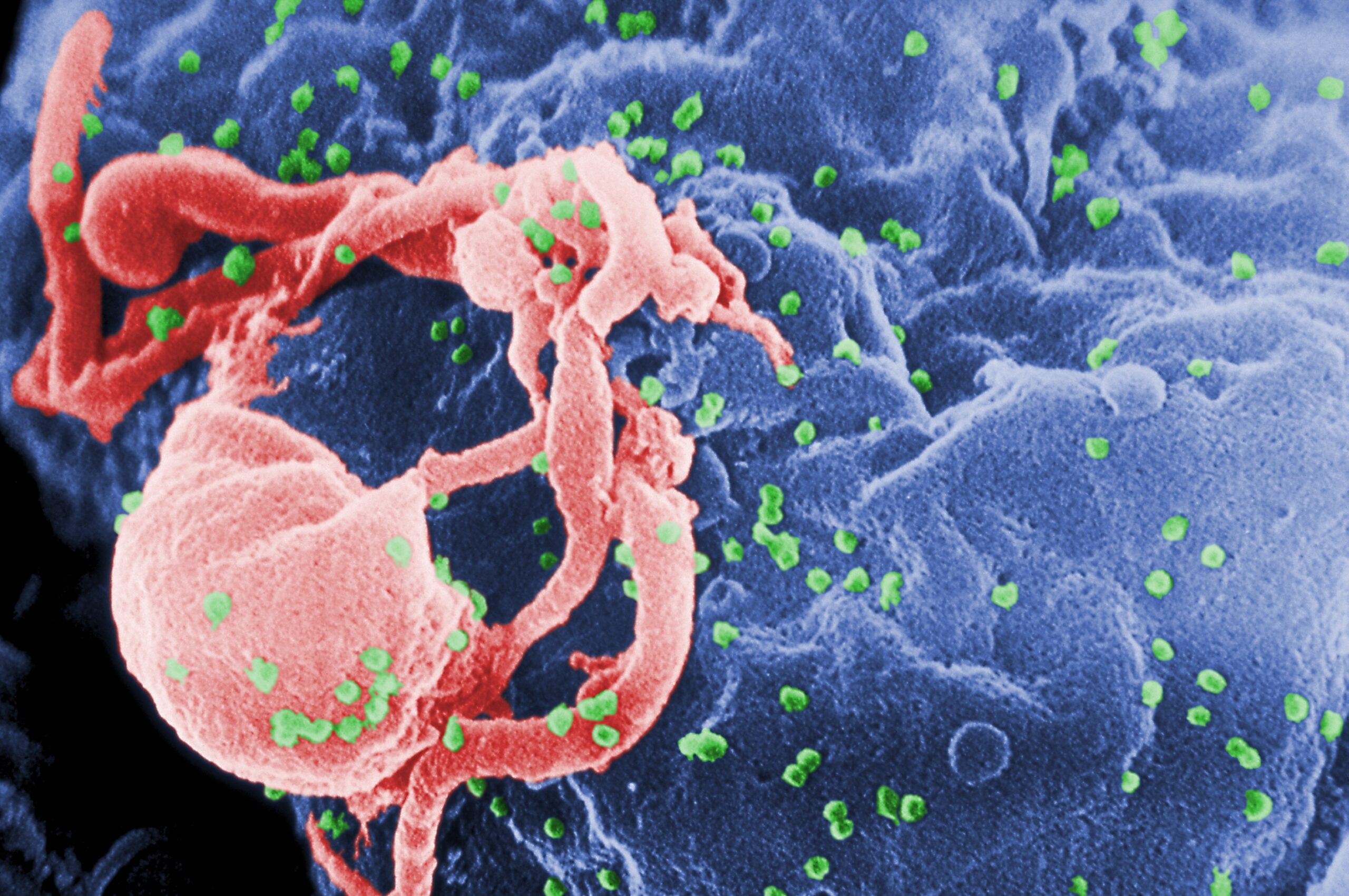
Every year more than 120,000 babies worldwide are born with or acquire HIV. For all of them, current medicine means lifelong antiretroviral therapy — assuming they can get it and keep getting it. A study published in Nature Microbiology raises the possibility of something different: a short course of treatment given in the first days of life that clears the virus and then stops.
In eight infant macaques given a three-part regimen beginning 72 hours after infection, researchers led by Oregon Health & Science University could find no detectable virus anywhere they looked, roughly a year after treatment ended.
Advertisement — ad space reserved
What was given
Three treatments, delivered over a few weeks: standard antiretroviral therapy; broadly neutralising antibodies that target the virus’s outer envelope; and leronlimab, an experimental monoclonal antibody that blocks CCR5, the cell-surface receptor most HIV variants transmitted at birth use to enter immune cells.
Each had been tried alone before and had failed to clear the virus permanently. Simpler two-drug combinations tested by the same team did not reliably work either. Only the full combination did.
Jonah Sacha of OHSU’s Oregon National Primate Research Center, a co-lead author who has worked on leronlimab for years, said there had been no reason to expect complete clearance. Nancy Haigwood, the virologist who proposed combining the therapies, described the team as astounded.
Why the timing is the mechanism
HIV is difficult to cure because it establishes a reservoir — copies of itself integrated into long-lived immune cells, invisible to drugs and to the immune system, ready to restart if treatment stops. That reservoir forms early.
The logic here is to intervene inside that window, before the reservoir is seeded. The paper’s title says as much: the combination limits viral reservoir seeding. Blocking CCR5 appears to be the key element — Sacha noted that, for reasons not yet understood, HIV strongly prefers that receptor for infecting cells. Exactly how the three components work together remains unclear.
Advertisement — ad space reserved
The limits, stated plainly
This was eight animals. It does not establish that the approach cures HIV in human newborns, and no human has been treated this way. Two of the three components are not approved for this use: antiretroviral therapy is standard care, but broadly neutralising antibodies and leronlimab remain in separate clinical trials. Any paediatric use would require new trials from the beginning.
The authors flag their own caveat, which is the honest one: deeper sampling of bone marrow or the central nervous system might have found latent virus they missed. “No detectable virus anywhere we looked” is a statement about the limits of looking as well as about the virus.
The three-day window is also demanding. It requires knowing an infant has been exposed, and having three therapies — two of them experimental — available immediately. In the countries where most paediatric HIV infections occur, that is a formidable logistical requirement, not a formality.
Why it still matters
Sacha’s stated view is that the regimen could move to clinical trials immediately for newborns, with newly exposed adults as a later question. Whether regulators and funders agree is a separate matter, and the gap between a striking primate result and a licensed treatment is where a great many promising HIV findings have stalled over four decades.
What makes this one worth watching is that it uses a combination of things that already exist rather than requiring a new discovery — and that the alternative it would replace is a lifetime of daily medication beginning in infancy.
Sources
Nature Microbiology, 10 August 2026, “Combination therapy with broadly neutralizing antibodies, antiretroviral therapy and CCR5 blockade limits viral reservoir seeding in infant macaque model of HIV”; OHSU News and EurekAlert releases; coverage by Medical Xpress, Inside Precision Medicine and Medical Daily.
Advertisement — ad space reserved
Leave a Reply