Yesterday’s total solar eclipse crossed Greenland, Iceland, Portugal and northern Spain, with millions across Europe seeing at least a partial eclipse. It has now passed, and will not be repeated on that path.
If you missed it, or watched it and want to know what you were looking at, here is what happened in those few minutes.
Advertisement — ad space reserved
The stages, in order
A total eclipse is not one moment but a sequence, and astronomers have names for each stage.
First contact is when the Moon’s edge first touches the Sun’s. For the next hour or so the Sun becomes a shrinking crescent — visible only through a proper filter, and barely noticeable to anyone not looking for it.
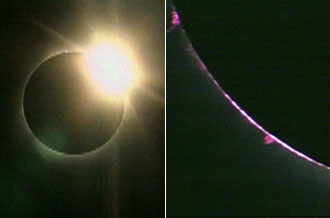
Baily’s beads appear as the crescent thins to nothing. The Moon’s edge is not smooth — it has mountains and valleys — so the last sunlight shines through the low points as a broken string of bright points. Francis Baily explained the effect in 1836, and it carries his name.
The diamond ring is what happens when only one bead remains: a single blazing point set on the faint circle of the corona. It lasts a second or two, at the start and again at the end of totality.
Totality follows, when the disc is fully covered and the corona — the Sun’s outer atmosphere, normally lost in glare — becomes visible.
What people reported
Accounts of totality are strikingly consistent across centuries and cultures. The temperature drops noticeably. Birds go quiet and some settle as though for evening. The light in the minutes beforehand turns strange — not simply dimmer, but thinner, with unusually sharp shadows.
Observers frequently describe seeing the Moon’s shadow arrive across the landscape, moving faster than anything they have watched before.
If your eyes hurt
One practical note, because the timing matters. Damage to the retina from looking at the Sun is painless at the time — the retina has no pain receptors — and any loss of vision typically becomes apparent hours later.
Anyone who looked at the partial phases without a proper filter and is now noticing blurred vision, a blind spot or distorted colour should see an optometrist or doctor rather than waiting to see whether it improves.
When the next one comes
Total eclipses happen somewhere on Earth every year or two, but the path of totality is a narrow band — often only around a hundred kilometres wide — so any given place waits centuries between them.
That is why people travel for them, and why the same faces turn up at eclipse after eclipse on different continents. It is also why yesterday mattered: for most of the people standing in that band, it was the only one they will see from home.
Eclipse path per Encyclopaedia Britannica’s 2026 events calendar. Eye-safety information follows standard optometric guidance; if you have any concern about your vision, seek professional advice.
Advertisement — ad space reserved
Leave a Reply