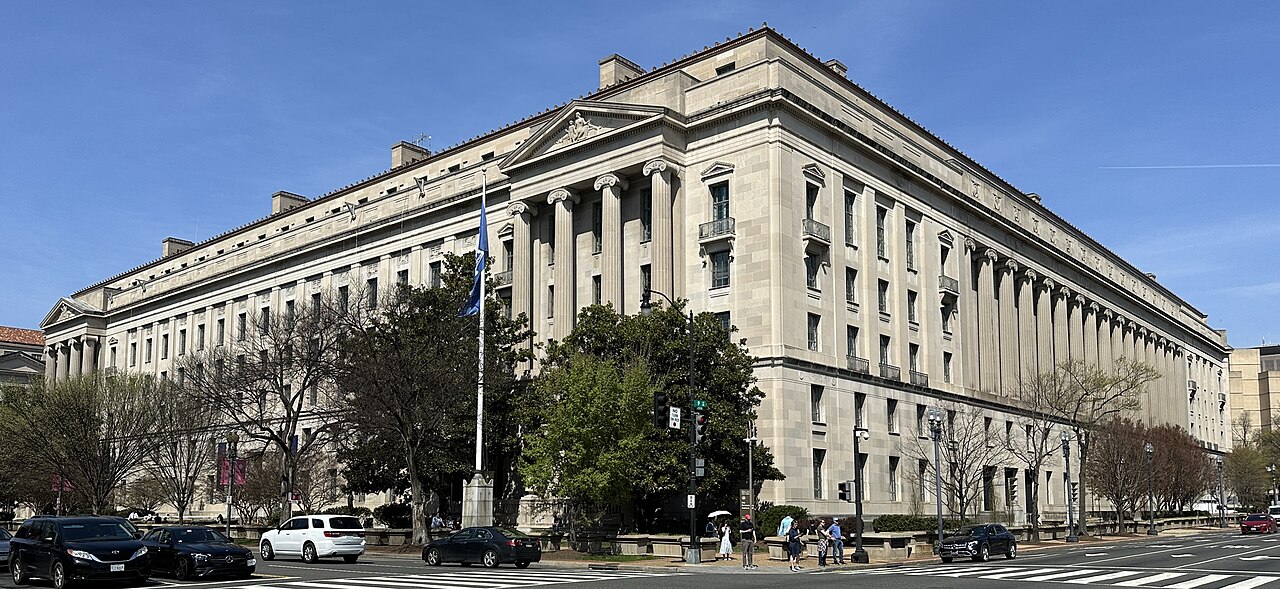
In a legal opinion issued on Wednesday 2 September 2026, the US Justice Department told states that they risk losing billions of dollars in federal funding for low-income residents unless they report undocumented immigrants living in their communities. The programmes named are Temporary Assistance for Needy Families, the block grant that funds state welfare programmes, and Supplemental Security Income, the federal benefit for elderly and disabled people with almost no income.
Democratic state attorneys general are widely expected to sue. The interesting part is not that there will be litigation. It is that the argument on both sides was largely written by the Supreme Court decades ago, and both sides know exactly which cases they will be citing.
Advertisement — ad space reserved
What an opinion like this actually is
A Justice Department legal opinion is not a law, a regulation or a court order. It is the executive branch’s statement of how it reads its own authority, and it binds the agencies that answer to it. In practice that is not nothing: agencies act on it, grant officers apply it, and a state that wants to test it has to be willing to have its funding withheld first and argue about it afterwards.
The two named programmes are not identical in structure. TANF is a block grant: federal money goes to state governments, which run their own programmes within federal rules. SSI is a federal benefit paid directly to individuals by the Social Security Administration, though most states add a supplementary payment of their own. Conditioning the first on state conduct is legally familiar territory. Conditioning the second is less obviously so, because the money is not the state’s to begin with.
The government’s argument
The administration’s position, in this opinion and in similar disputes, rests on the spending power. Congress may attach conditions to federal money, and states that dislike the conditions may decline the money. On that reading, a requirement to share information about who is living in a state is a condition of participation like any other, and a state that refuses is choosing to forgo funds rather than being compelled to do anything.
Supporters of the approach add a practical point: federal immigration enforcement depends on information that state and local agencies hold, and a state that deliberately withholds it is not neutral — it is obstructing a federal function that the Constitution assigns to the national government.
The states’ argument
The states will lean on three lines of authority. The first is South Dakota v. Dole (1987), which allows Congress to attach conditions to federal funds but requires that the conditions be stated unambiguously, be related to the federal interest in the programme, and not be so heavy as to amount to compulsion. A condition about immigration reporting attached to a welfare block grant invites the question of what it has to do with helping needy families.
The second is the anti-commandeering doctrine from Printz v. United States (1997), which holds that the federal government may not conscript state officials into administering a federal regulatory programme. Requiring state employees to identify and report residents to federal immigration authorities is close to the centre of that rule.
The third is the coercion holding in NFIB v. Sebelius (2012), where the Court found that threatening a state’s entire existing Medicaid funding to force acceptance of an expansion was “a gun to the head”. States will argue that threatening the whole of a state’s TANF grant over an unrelated condition is the same manoeuvre.
None of this makes the outcome obvious. Courts have upheld a range of funding conditions, and the composition of the current Supreme Court is not the one that decided Sebelius. What can be said is that the legal questions are old, well-mapped, and unlikely to be resolved quickly.
Advertisement — ad space reserved
Who is standing underneath the argument
While that gets litigated, the programmes involved are already shrinking. New data indicate that close to 10 million people, including some 2.5 million children, have lost health coverage since the start of the current administration — and that is before new work requirements and further cuts to Medicaid and the Children’s Health Insurance Program take full effect. Five million fewer people are receiving SNAP food assistance following the 2025 budget reconciliation package.
A second effect is harder to measure and better documented than most people assume: when benefit systems become associated with immigration enforcement, eligible people stop applying. That includes US citizen children in mixed-status households, who are entitled to the assistance whatever their parents’ status. Researchers have tracked this chilling effect through previous rounds of public-charge rulemaking, and it does not require any actual reporting to occur — the announcement is sufficient.
We have seen how invisible those exits can be at state level. In Indiana, 82,000 people left the food assistance rolls and the state agency could not say how many were removed for ineligibility and how many for paperwork. If the reporting condition takes effect, the same measurement problem will apply nationally: it will be very hard to distinguish people who were found ineligible from people who were frightened off.
What to watch
Three things will tell you where this goes. Whether the administration actually withholds money from a state, or leaves the opinion as a warning. Whether any court grants a preliminary injunction before funds are interrupted, which is what usually determines who has the leverage. And whether the condition is written into grant terms — because a condition that appears in a signed grant agreement is much harder for a state to escape than one asserted in a legal opinion.
Advertisement — ad space reserved
Sources
- US Department of Justice legal opinion on state reporting and federal benefit funding, 2 September 2026
- Democracy Now!, headlines for 4 September 2026
- South Dakota v. Dole, 483 US 203 (1987); Printz v. United States, 521 US 898 (1997); NFIB v. Sebelius, 567 US 519 (2012)
- Published coverage data on health insurance and SNAP participation following the 2025 budget reconciliation act
Leave a Reply