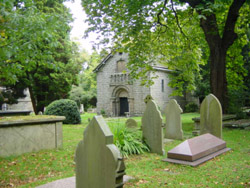
A group of churches in Yorkshire has apologised after ornaments, flowers and other items were removed from graves at St Martin’s Church in Hayton and put in a wheelie bin. Families said they had not been warned. Among the items were a teddy bear left beside the grave of a baby who died at birth 23 years ago, and statues of doves.
Advertisement — ad space reserved
The rules that sit behind this
Incidents like this recur across England, and they are not usually the result of anyone deciding to be cruel. They arise from a system most bereaved families have never heard of.
A Church of England churchyard is consecrated ground governed by ecclesiastical law rather than by ordinary property rules. What may be placed on a grave is set out in regulations issued by the diocese, and those regulations are generally restrictive: they commonly permit a headstone of specified material and dimensions, and cut flowers, while excluding ornaments, statues, toys, lights, kerbing and planted borders.
Anything outside the rules technically requires permission from the diocesan court. In practice, incumbents and churchwardens generally leave items alone for years, which means families reasonably conclude they are permitted. Periodically a tidy-up happens, and the gap between the written rule and the settled practice becomes visible all at once.
Why the churches give the reasons they do
The justifications offered are usually practical and, taken on their own terms, reasonable. Mowing and maintenance become difficult and slow. Glass and ceramic break and leave fragments. Items degrade and blow around. Churchyards are often maintained by a handful of volunteers.
There is a theological strand too, less often articulated publicly: a tradition of uniformity in burial grounds, expressing that the dead are equal before God regardless of what a family can afford to place above them.
None of that is what the families are objecting to.
Advertisement — ad space reserved
The objection is about notice, and about the bin
The complaint reported is that nobody was told beforehand, and that the items were put in a wheelie bin.
Those two things are separable from the rule itself, and they are the entire substance of the harm. A notice on the gate weeks in advance, an offer to return items to families, or a box in the porch rather than a bin would have enforced exactly the same regulation without any of this. The rule was applied; the pastoral part was not done.
A teddy bear beside a grave 23 years after a baby died at birth is not decoration. Grief researchers describe continuing bonds — the maintenance of a relationship with someone who has died — as normal rather than pathological, and tending a grave is one of the ordinary forms it takes. Removing the object without warning interrupts something people have been doing for decades.
Why it is worth reporting
This is a small local story, and it turns on a question that recurs wherever an institution holds authority over something intensely personal: whether a rule can be right and its enforcement still be a failure.
The churches have apologised, which suggests they think so too. The practical remedy elsewhere has generally been the same — clear signage, written notice before any clearance, and a period during which families can collect what has been removed.
Sources
Advertisement — ad space reserved
Leave a Reply