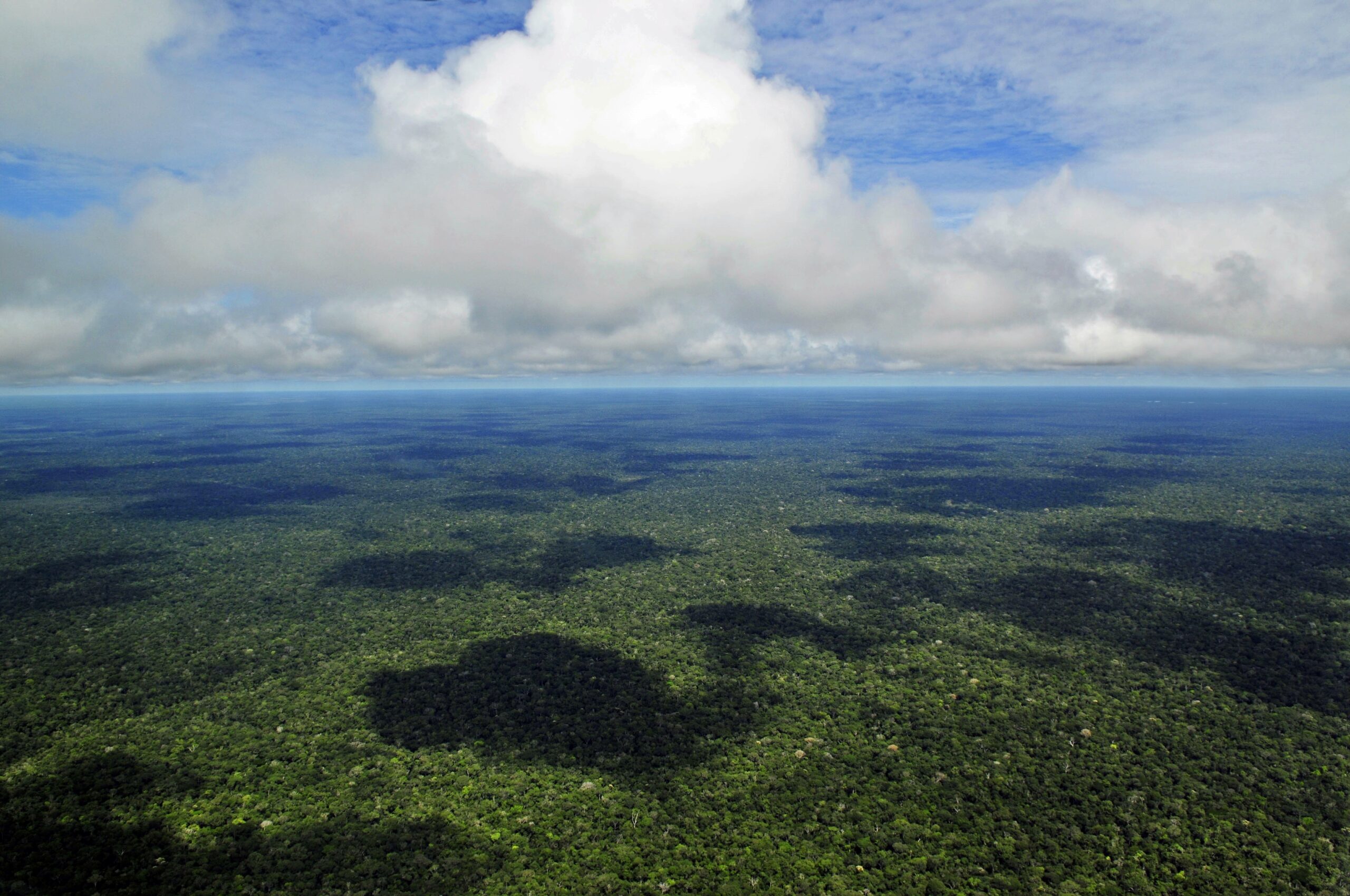
Brazil’s National Institute for Space Research has reported that deforestation in the Amazon fell to 2,874 square kilometres between August 2025 and July 2026 — a 37% drop on the previous year, and the lowest figure since the institute’s current satellite monitoring began in 2016.
Environmental news is so reliably grim that a genuine improvement deserves proper attention — including attention to what the number does and does not mean.
Advertisement — ad space reserved
How anyone knows
Nobody walks the Amazon counting trees. The figure comes from satellites passing overhead repeatedly, photographing the same ground and comparing images over time.
Cleared forest looks different from standing forest — in colour, in texture, in how it reflects light at wavelengths the human eye cannot see. Software identifies changed areas and analysts verify them. Because the method has been consistent since 2016, year-on-year comparisons are meaningful in a way that comparisons across different methods would not be.
Cloud is the main difficulty. The Amazon is cloudy, and optical satellites cannot see through it, which is why radar-based systems are increasingly used alongside them.
Putting 2,874 square kilometres in perspective
It is still an enormous area — roughly the size of Luxembourg, cleared in twelve months.
Both things are true at once: the rate has fallen substantially, and forest is still being lost at a scale that would be a national emergency almost anywhere else. A declining rate of loss is not recovery. It is slower damage.
This is worth stating plainly because a 37% fall can be reported in a way that suggests the problem is being solved. The forest is smaller this year than last year.
Why it matters beyond Brazil
The Amazon does three things that reach far past its borders.
It stores carbon — an immense quantity, released when trees are cut or burned. It moves water, drawing moisture from the ground and releasing it into the air, generating rainfall that falls on farmland thousands of kilometres away. And it holds a share of the planet’s species that no other single place matches.
The water function is the least understood and possibly the most immediately consequential. Agriculture across South America depends on rainfall that the forest itself helps produce. Clearing the forest to expand farmland can, past a certain point, undermine the farming it was cleared for.
Advertisement — ad space reserved
What tends to move the number
Deforestation rates respond to a mix of enforcement, economics and weather, and separating them is genuinely difficult.
Enforcement matters: satellite detection is only useful if someone acts on it, and the presence or absence of inspectors, fines and prosecutions shows up in the figures.
Commodity prices matter: land is cleared because cattle and crops are worth money, so falling prices reduce clearing regardless of policy.
Weather matters: a wet year makes burning harder.
Because these move together, a single good year is not proof that a policy worked, and a single bad year is not proof it failed. Sustained direction over several years is the evidence that counts.
Degradation is not measured the same way
There is a category the headline figure does not capture. Clear-cutting is easy to see from orbit. Degradation — selective logging, understorey fires, thinning that leaves canopy standing — is much harder, and in some years affects a larger area than outright clearance.
Degraded forest holds less carbon, supports less wildlife and burns more easily. It is also, in a photograph, still forest.
So a fall in deforestation is genuinely good news about one measurable thing, while a related and serious problem sits partly outside the frame.
Why report improvements at all
Coverage of the environment is overwhelmingly a record of deterioration, and there is a cost to that. Readers who hear only that everything is getting worse reasonably conclude that nothing can be done.
A 37% fall is evidence against that conclusion. Whatever combination of causes produced it, it demonstrates that the trend is not fixed — that these numbers respond to decisions people make.
Reporting that honestly means holding both halves: this is real progress, and the forest is still shrinking.
Source: Brazil’s National Institute for Space Research (INPE), reported by AFP via The Straits Times, August 2026.
Advertisement — ad space reserved
Leave a Reply