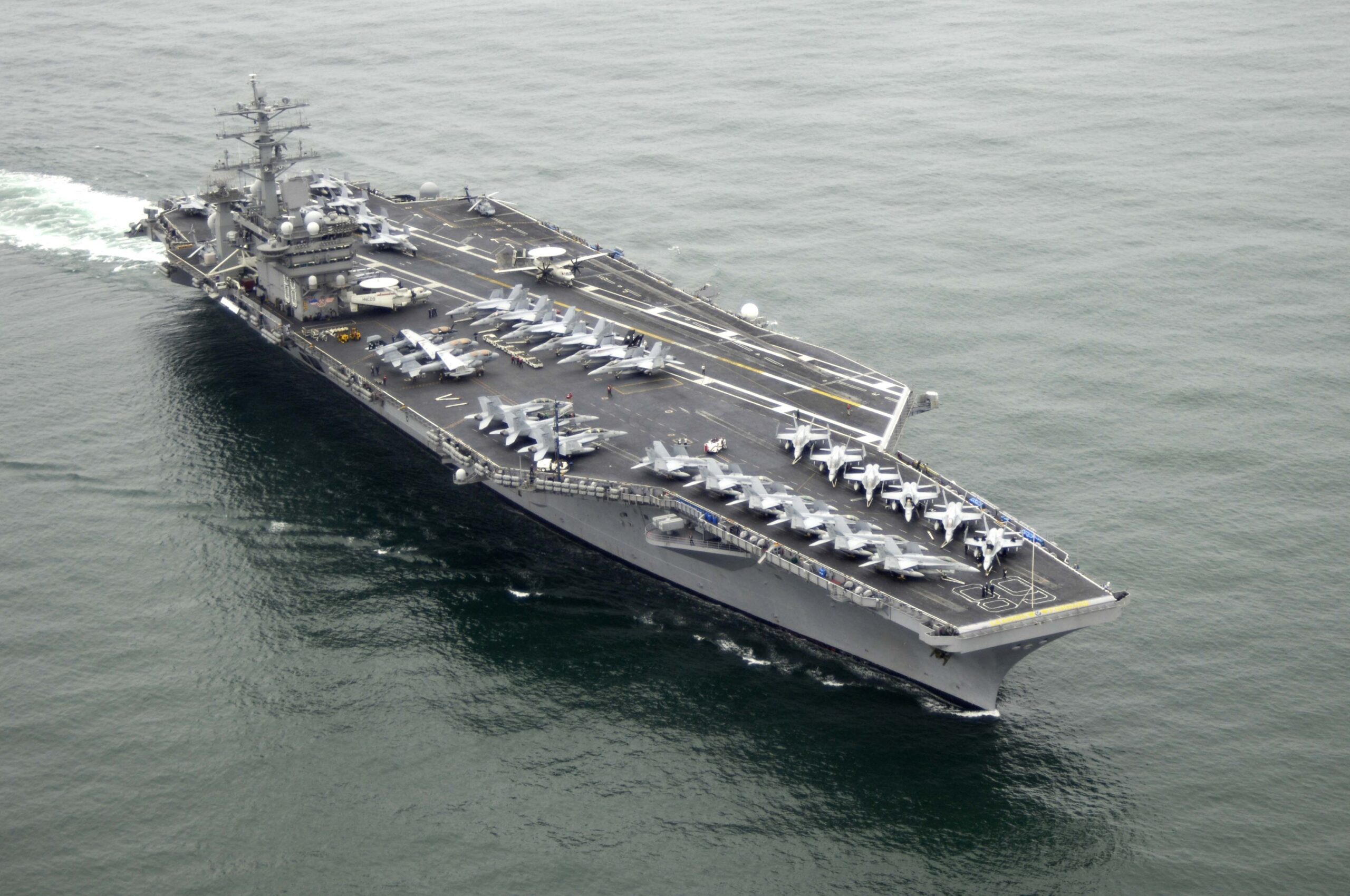
The United States is sending the aircraft carrier USS George Washington to the Middle East to relieve the USS Abraham Lincoln, which has been on station for an extended deployment during the war with Iran.
The numbers attached to that sentence are the story. According to reporting by the Wall Street Journal, the Abraham Lincoln has been deployed for more than 250 days and has not made a port call in 200. Concerns have been raised about crew morale and living conditions on board.
Advertisement — ad space reserved
Why 200 days without a port call matters
A US carrier deployment is conventionally planned at around six to seven months, with regular port visits built in. Those stops are not tourism. They are when crews get off the ship, when mail and fresh food come aboard in quantity, when maintenance that cannot be done under way gets done, and when sailors contact families properly.
A Nimitz-class carrier holds well over 5,000 people in a space with no privacy, working rotating shifts in continuous operations. The ship itself can stay at sea almost indefinitely — it is nuclear-powered, and its limits are food, spare parts and people. The people are the binding constraint, and 250 days without stepping ashore pushes hard against it.
There is a maintenance dimension too. Extended deployments defer scheduled shipyard work, which shortens the interval before the next one and compresses the readiness cycle for the whole fleet. Every stretched deployment borrows from a future one.
What the swap signals
Relieving a carrier rather than withdrawing it says the United States expects to keep a carrier presence in the region. Carriers are the visible instrument of American commitment; removing one without replacement would be read across the Gulf as a signal in itself, particularly while the dispute over who controls the Strait of Hormuz is unresolved and the naval blockade of Iranian ports remains in force.
It also confirms something about the war’s expected duration. Rotating a fresh carrier in is a decision about the next six months, not the next six weeks.
Advertisement — ad space reserved
The part that rarely gets covered
Coverage of naval deployments tends to treat ships as pieces on a board — one carrier out, one carrier in, a change in posture. The crew conditions reporting is a useful corrective, because sustained military presence has a cost that is paid by people rather than by budgets, and it accumulates quietly.
The US Navy has not published details of the transition timetable, and neither ship’s precise position is public. What is on the record is the length of the Abraham Lincoln’s deployment, the fact that a relief is being sent, and that questions about conditions aboard were serious enough to feature in the decision.
Sources
Wall Street Journal reporting by Shelby Holliday and Yoko Kubota, summarised in the Just Security Early Edition of 14 August 2026.
Advertisement — ad space reserved
Leave a Reply