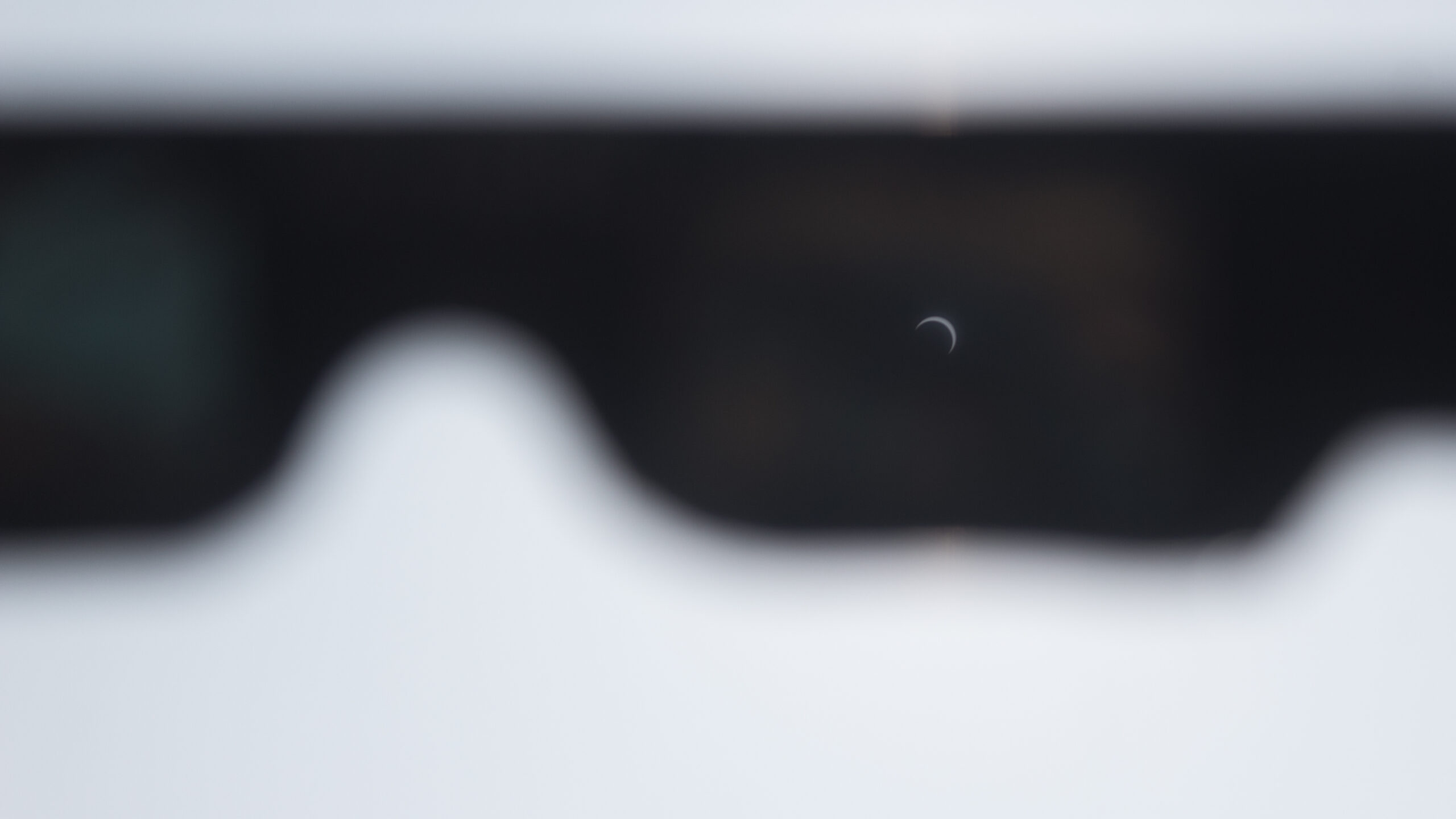
On 12 August, a total solar eclipse crossed Greenland, Iceland and northern Spain. Also on 12 August, according to a claim that had been circulating online for more than a year, Earth was going to lose gravity for seven seconds at 14:33 UTC, killing 40 million people in falls.
One of these things happened. The eclipse is worth revisiting not for its own sake — we covered what people actually saw — but because the hoax attached to it is an unusually clean specimen of how a false story is built, and worth taking apart while it is fresh.
Advertisement — ad space reserved
The claim
The story held that a secret NASA document called “Project Anchor” leaked in November 2024, revealing an $89 billion programme to survive a seven-second gravitational anomaly. The cause was said to be intersecting gravitational waves from colliding black holes. Predictions of the consequences were specific: unsecured objects and people rising fifteen to twenty metres before crashing down, tens of millions of deaths, infrastructure destruction, a decade of economic collapse. Some versions added bunkers built for selected officials.
Fact-checkers traced the earliest widely shared version to an Instagram account known for fabricated content, posting on 31 December 2025. It spread from there to TikTok, X, Facebook, Reddit, Threads and YouTube. NASA told Snopes plainly that Earth would not lose gravity on 12 August 2026. No document called Project Anchor has ever been found.
Why it worked
It was anchored to something real. This is the single most important feature. A total eclipse on 12 August 2026 was genuinely scheduled, precisely calculable, and had been in astronomical tables for decades. Anyone who checked whether something unusual was happening that day found confirmation that something was — just not the thing being claimed. A verifiable fact sitting next to a fabricated one lends its credibility across.
The specificity was the point. Vague predictions are easy to dismiss. A time to the minute, a budget to the billion, a probability of 94.7 per cent, a height of fifteen to twenty metres — these details are load-bearing, because unfalsifiable precision reads as insider knowledge. Nobody invents a decimal place unless they have data, is the intuition the format exploits.
It borrowed real physics vocabulary. Gravitational waves exist, black holes collide, and the detections are genuinely news. The claim wired real terms into a nonsense mechanism. Gravitational waves from black hole mergers do pass through Earth, and they distort spacetime by a fraction of the width of a proton — which is why detecting them required instruments four kilometres long and won a Nobel Prize.
The secrecy element made checking pointless. If the premise is that the agency is concealing this, then the agency’s denial confirms the story. A claim structured this way cannot be disproved by evidence from the accused party, which is precisely why it is structured that way.
Advertisement — ad space reserved
Why the physics does not work
Gravity is not a field that can be switched off. It is a consequence of mass. Earth’s gravity exists because Earth has roughly six thousand billion billion tonnes of it, and it would take removing that mass to remove the effect. Nothing in an eclipse changes Earth’s mass, and nothing in an eclipse changes the Moon’s or the Sun’s.
The Sun and Moon do exert gravitational pull on Earth — that is what tides are. During an eclipse the Sun and Moon are aligned, which is why eclipses coincide with slightly larger spring tides. The effect is a matter of centimetres of water, not people floating.
The checks that would have caught it
Three questions, none requiring any physics knowledge, dispose of almost every claim of this kind.
First: where did this originate? Not who shared it — who posted it first. Here the trail led to a single account with a history of invention, not a research institution, journal or agency.
Second: does the named source exist? A leaked NASA document with a name and a budget should be findable. If nobody can produce it — not the original poster, not anyone resharing — that absence is the answer.
Third: who else would know? An event of this magnitude would involve every space agency, every physics department and every insurance company on the planet. Silence from all of them is not evidence of a cover-up; it is evidence that there is nothing to be silent about.
One footnote on the shape of these things. This hoax has an ancestor: a widely circulated claim that the world would go dark for six minutes on 2 August 2025, which was a garbled version of a real eclipse due on 2 August 2027. The pattern repeats because it works — take a genuine astronomical event, move it, exaggerate it, add a cover-up. Expect another one before 2027.
Sources
Snopes fact check and NASA’s response to it; Evidence Network analysis of the claim’s origins; contemporaneous debunking by regional broadcasters and science desks.
Advertisement — ad space reserved
Leave a Reply