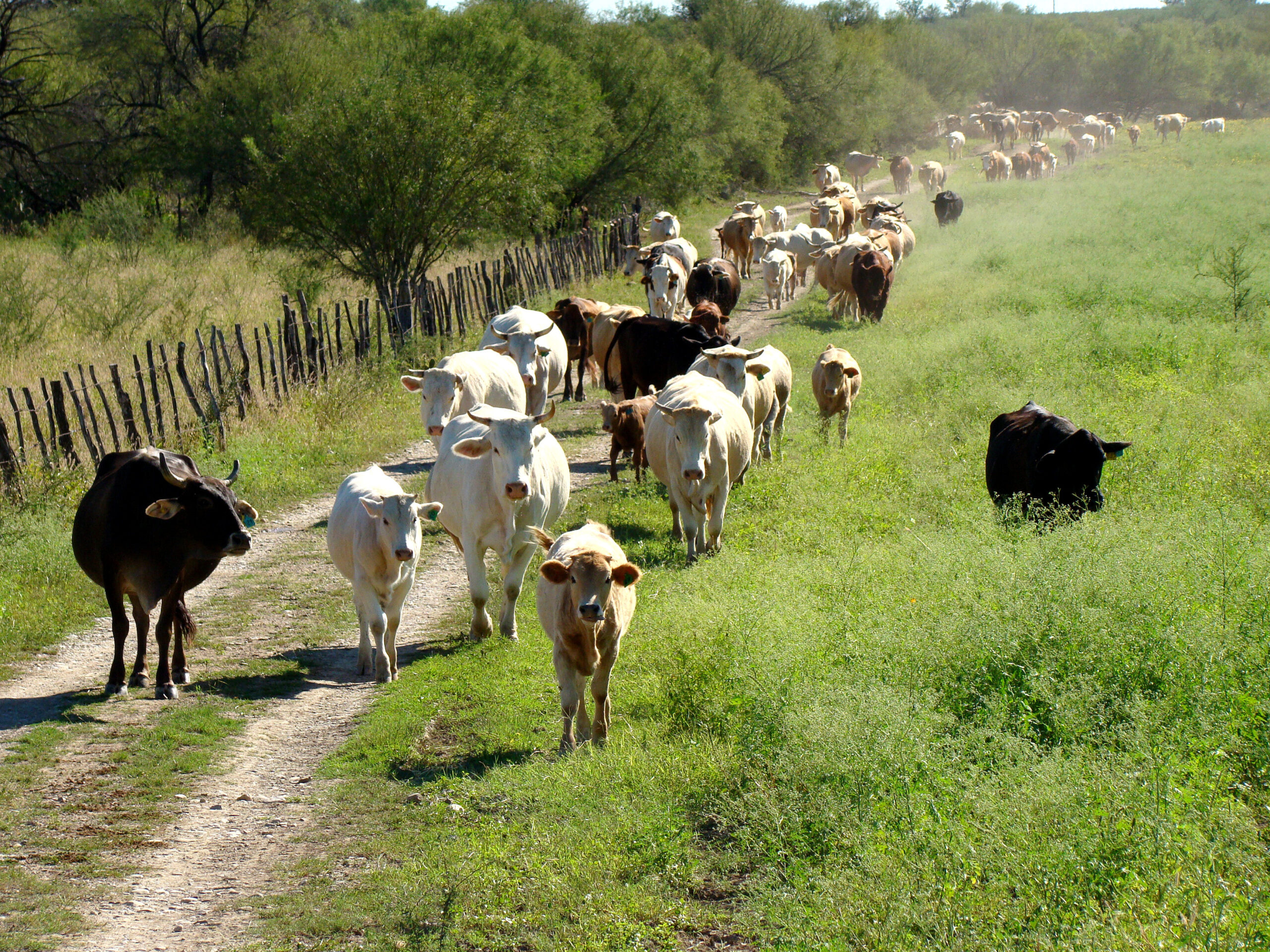
The United States reopens its border to Mexican cattle on Monday 24 August, ending a suspension of more than a year imposed over the New World screwworm. The trade was worth about $1.2 billion to Mexico last year. It will not resume at anything like its former volume — the reopening starts at 700 head a day.
What closed the border
The New World screwworm is the larva of a fly, Cochliomyia hominivorax. Unlike most flies that feed on dead tissue, its larvae feed on living flesh, entering through a wound as small as a tick bite and burrowing inward. Untreated infestations kill livestock. The species can infest any warm-blooded animal.
North America eradicated it decades ago, and the method used is one of the more elegant tools in agriculture: mass-rear the flies, sterilise the males with radiation, and release them in enormous numbers. Wild females mate once. If they mate with a sterile male, they produce nothing, and the population collapses. It was this technique that pushed the screwworm south out of the United States and Mexico in the twentieth century, and it is the technique being used again now.
The current outbreak was detected in southern Mexico in November 2024 and moved north. The US Department of Agriculture suspended cattle imports, lifted the suspension in February 2025 under a new inspection protocol, then re-imposed it in May 2025 after what it called an unacceptable northward advance.
From Plain Sight News
News explained in plain language. About Plain Sight News.
What the closure did to both sides
Before the border shut, Mexico exported roughly 1.2 million head of cattle to the United States each year, mostly from its northern states. Those animals are typically young cattle that cross the border to be fattened and slaughtered in the US. Remove them and the American supply chain loses an input it had built around.
The effect showed up in price. US beef reached record highs during the closure, with the import halt compounding an existing domestic cattle shortage. Reducing those prices is part of the stated motivation for reopening.
On the Mexican side, ranchers who could no longer export sold into the domestic market instead, at close to 40 per cent less than they had been getting in the United States. Martín Alfonso Ibarra, a 58-year-old rancher in Sonora, told the Associated Press that the halt cut his income by 40 per cent last year. The sector was already weakened by drought.
Why the reopening is deliberately slow
The USDA is staging it. Imports resume first at Douglas, Arizona, opposite Agua Prieta in Sonora, with two further crossings in New Mexico — Santa Teresa and Columbus — to follow, without fixed dates. The reopening is conditional on Mexico maintaining its screwworm control plan.
The volumes are capped and rise on a schedule. Arturo Ruiz, the official responsible for animal health in Sonora, told the AP that only 700 cattle a day will be allowed through in the first week, rising to 900 in the second and increasing gradually to 1,300 a day. Against a pre-closure average of roughly 1.2 million head a year — around 3,300 a day — that is a fraction of the old flow.
Every animal has to be inspected and treated by authorised veterinarians before entering pre-export pens, then inspected again. The cap is not arbitrary caution: inspection capacity is the actual bottleneck, and a protocol only works if the people carrying it out are not overwhelmed.
From Plain Sight News
Got a story we should be covering? Send it to the newsroom.
The awkward fact about the ban
It did not work as a barrier. The screwworm was detected in Texas and New Mexico in mid-2026 despite the closure, with more than 30 cases reported. Flies do not present documents at ports of entry, and the pest had already moved north through Central America.
Defenders of the closure argue this is the wrong test: the point was to avoid importing large numbers of potentially infested animals into feedlots deep inside the United States, which would have seeded the pest far from the border rather than at it. Critics counter that a measure which imposes about $1.2 billion of annual cost and does not achieve exclusion should have been reconsidered sooner, and that the money would have done more work in sterile-fly production and surveillance. Both arguments are live, and the outbreak’s trajectory over the next year is what will settle them.
Where the outbreak stands
Mexico reports 1,969 active screwworm cases — fewer than half the number recorded a year ago. Authorities describe that as evidence of progress while acknowledging that eradication will take time. The outbreak has affected the great majority of Mexican states since 2024.
Ibarra’s assessment, to the AP, was blunter than the official framing: this is not over yet. The reopening is conditional, staged and reversible, and it has been reversed once already.
From Plain Sight News
How we source and correct our reporting. Our editorial standards.
Sources: Associated Press; USDA APHIS; Reuters via Farm Policy News.
Leave a Reply