Newly released Epstein files expose years of disturbing correspondence with one of Dubai’s most powerful businessmen, alongside efforts to gain access to senior members of the UAE royal establishment.
The latest release of Jeffrey Epstein files has drawn fresh scrutiny to his connections in the United Arab Emirates, revealing a disturbing combination of sexually explicit correspondence, references to photographs of women, a mysterious “torture video,” and attempts to establish relationships with some of the UAE’s most powerful figures.
At the center of the most disturbing correspondence is Sultan Ahmed bin Sulayem, the longtime chairman and chief executive of Dubai-based logistics giant DP World and one of the most influential businessmen in the Emirates.
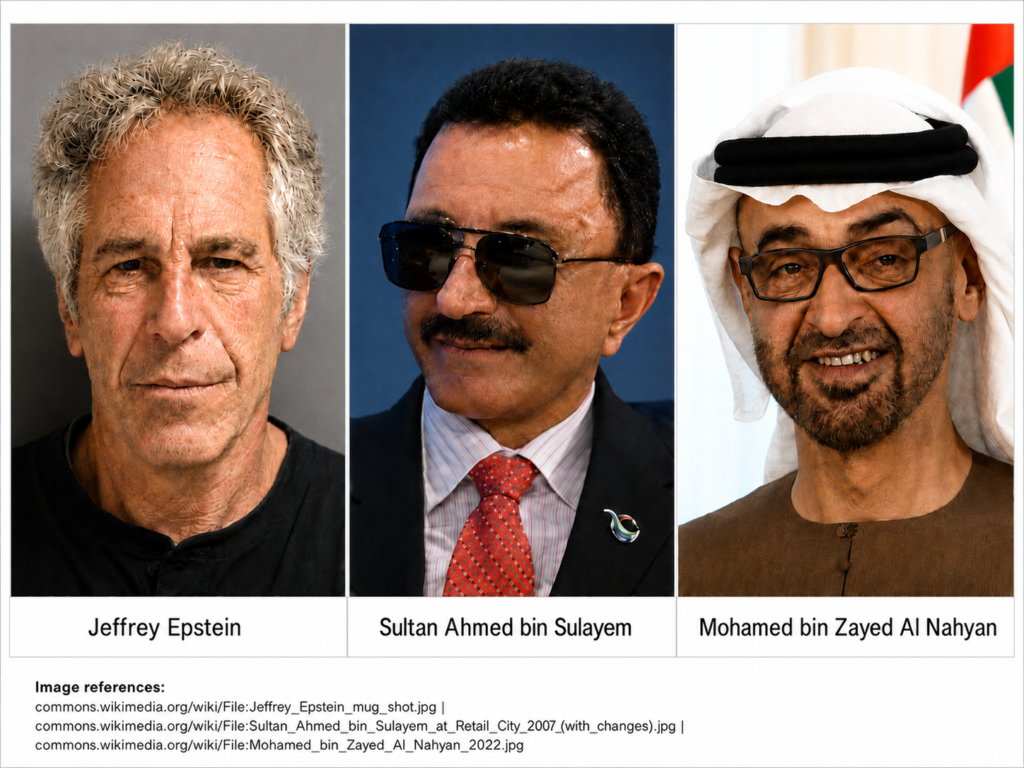
Bin Sulayem is not a UAE royal or sheikh. But his position placed him close to the center of Dubai’s economic establishment, and the newly released records show that his relationship with Epstein continued for years after Epstein had already been convicted in Florida in 2008 of soliciting prostitution from a minor.
The correspondence is considerably darker than a simple record of business meetings.
In an email dated April 24, 2009, Epstein wrote to a recipient whose email address was initially redacted:
“where are you? are you ok, I loved the torture video”
The recipient responded that he was in China and would be in the United States during the second week of May.
Republican Congressman Thomas Massie later drew attention to the exchange and identified the recipient as Sultan Ahmed bin Sulayem. The U.S. Justice Department subsequently pointed to other unredacted records connecting the correspondence to bin Sulayem. The Associated Press reported that U.S. officials had effectively associated him with the exchange. (AP News)
The files do not disclose what the “torture video” actually depicted, and there is no released evidence establishing that it showed a real act of torture rather than staged material. That distinction is important.
What is documented, however, is that Epstein said he had watched something he described as a “torture video” and told bin Sulayem that he had “loved” it.
The correspondence did not end there.
Emails reviewed by the Financial Times show bin Sulayem and Epstein exchanging highly explicit messages concerning women and sexual encounters over a period of years. (Financial Times)
One particularly striking email was sent in June 2013.
According to the Financial Times, bin Sulayem sent Epstein information about a woman including her age, height, weight and bra size. He then asked Epstein whether the woman might actually be male.
Four photographs appeared to have been attached to the email.
The photographs themselves were not included in the material publicly released by the Justice Department, so their exact contents cannot independently be established from the files currently available.
Epstein responded with a crude remark about the woman’s hands. (Financial Times)
Other exchanges reportedly contained references to escorts, sexual massages and pornography. In another message described in the released correspondence, bin Sulayem told Epstein about a woman he had met and described the encounter in explicitly sexual terms. (The Guardian)
These were not isolated communications between two men who had briefly crossed paths.
Reuters reported that the documents show a relationship lasting more than a decade, involving business, personal communications, visits and introductions. (Reuters)
The revelations eventually had major consequences.
In February 2026, amid growing international scrutiny of his relationship with Epstein, bin Sulayem resigned as both chairman and chief executive of DP World. Reuters reported that his appearance in the Epstein files and the escalating controversy surrounding the relationship were behind the company’s decision to act. (Reuters)
Financial institutions also reacted.
British International Investment, the UK government’s development finance institution, suspended new investments alongside DP World, while major Canadian pension fund La Caisse paused additional capital deployment connected with the company pending clarification. (AP News)
DP World is not a minor regional company. It is one of the world’s largest port and logistics operators and says it handles roughly 10 percent of global trade. (Yahoo Finance)
But the UAE connection goes beyond bin Sulayem.
Separate emails reveal Epstein attempting to penetrate the Emirates’ royal and political leadership.
In November 2010, Andrew Mountbatten-Windsor — then Prince Andrew and serving as Britain’s special representative for international trade and investment — was visiting the UAE with Queen Elizabeth II.
During that official state visit, Andrew emailed Epstein about Sheikh Abdullah bin Zayed Al Nahyan, the UAE foreign minister and a senior member of Abu Dhabi’s ruling Al Nahyan family.
Andrew told Epstein that Sheikh Abdullah thought highly of him and wanted to introduce him to Sheikh Mohamed bin Zayed Al Nahyan, commonly known as MBZ, who was then crown prince of Abu Dhabi and is now president of the UAE. (Financial Times)
The communication is particularly remarkable because Epstein had already been convicted.
Rather than being excluded from elite political circles following his conviction, the emails suggest he was actively seeking new access to them.
Epstein even supplied Andrew with suggestions about how he should be presented to Sheikh Abdullah, emphasizing his financial knowledge, scientific interests and supposed trustworthiness. (The Guardian)
Earlier that same month, Epstein told Andrew that he had met both Sheikh Abdullah in Abu Dhabi and Sheikh Mohammed bin Rashid Al Maktoum, ruler of Dubai.
Further correspondence discussed future contact and possible meetings. Epstein later travelled to the UAE in 2011 for a planned meeting involving Sheikh Abdullah, although the meeting was reportedly cancelled. (Financial Times)
There is no evidence in these emails that Sheikh Abdullah, MBZ or Sheikh Mohammed bin Rashid participated in Epstein’s sexual crimes, and none should be implied merely because they appear in his correspondence.
There is also an important distinction between those royal contacts and bin Sulayem.
The disturbing sexual and “torture video” correspondence currently documented in the released files concerns Sultan Ahmed bin Sulayem, not the UAE president or the other sheikhs named in Epstein-related correspondence.
Nevertheless, the two strands of evidence reveal how deeply Epstein attempted to embed himself within the UAE’s circles of influence.
On one level, there was an unusually close relationship with a senior Dubai businessman whose communications with Epstein included discussions about women, sexual services, photographs and the unexplained “torture video.”
On another, Epstein was using his relationship with a British royal to pursue introductions to members of the UAE’s ruling families.
The files therefore raise a broader question that extends far beyond Dubai:
How was a man already publicly convicted of a sex offence involving a minor still being welcomed, recommended and introduced inside some of the world’s most exclusive business and political networks?
The Epstein files do not prove that every powerful person who met or corresponded with him was involved in his crimes.
But they increasingly document something else that is difficult to ignore: even after his conviction, Epstein remained capable of moving through extraordinary networks of wealth and influence — and the United Arab Emirates formed a significant part of that world.
This version is about 1,100 words and keeps the evidence separated carefully: the “torture video,” explicit sexual emails and photographs are connected to Sultan Ahmed bin Sulayem, while the separate royal-network material concerns Sheikh Abdullah bin Zayed, MBZ and Sheikh Mohammed bin Rashid. (Financial Times)
Leave a Reply