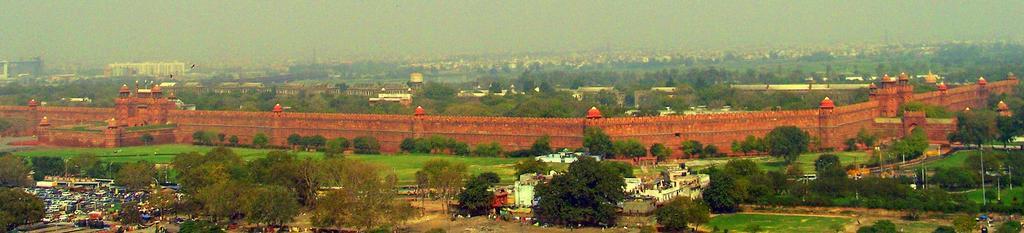
India marked eighty years of independence on 15 August, with Prime Minister Narendra Modi hoisting the national flag at the Red Fort in Delhi and delivering his thirteenth consecutive Independence Day address — a run that began in 2014.
The ceremony followed the established form: a guard of honour drawn from the Army, Navy, Air Force and Delhi Police, and a 21-gun salute fired with indigenously produced 105mm light field guns. The prime minister spoke afterwards with NCC cadets and students among the invited guests.
Advertisement — ad space reserved
The seven streams
The structural centrepiece of the speech was a set of seven priority areas, framed as Shakti ki Sapt Dhara — seven streams of strength: manufacturing; agriculture and food processing; technology and innovation; Gati Shakti, the infrastructure and logistics programme; Raksha Shakti, meaning defence capability; the green and blue economy; and India’s soft power.
Semiconductors featured prominently. Modi argued that chips now underpin electronics, medical equipment and transport systems alike, continuing a theme from last year’s address, when he announced domestically made chips. Energy security was the other recurring emphasis.
The organising ambition remains Viksit Bharat — developed-nation status by 2047, the centenary of independence. He also said India should aim to compete in every event at the 2036 Olympics, a games New Delhi has bid to host.
The floods
Modi acknowledged the severe flooding and landslides affecting several parts of the country, saying the government understood the hardship families had endured and that the nation stood with them. Odisha is among the states worst affected by heavy rain this week.
That the floods appeared as a passage in a national address rather than as the address’s subject is itself notable — a reminder that Independence Day speeches are set-piece statements of direction rather than responses to the week’s events.
Advertisement — ad space reserved
The contested line
One passage will generate more domestic argument than the economic programme. Modi called for the identification of what he termed dimaagi Naxals — literally “mental” or “intellectual” Naxals, meaning people he described as holding a Maoist mindset — saying such people had established themselves in the corridors of power and needed to be isolated for the country to keep developing.
Variants of this phrase have been used in Indian politics before, and they are contentious precisely because the category is undefined. Supporters read it as a warning about ideological obstruction of development projects. Critics read it as language that casts lawful political opposition, academics and activists as adjacent to an armed insurgency. Both readings will be aired at length in the Indian press over the coming days.
Eighty years
Independence in 1947 came with partition, and the anniversary carries that history alongside the celebration. What is measurably different at eighty is scale: the world’s most populous country, its fourth-largest economy by nominal output, a space programme, and a domestic semiconductor push — none of which resolves the questions about inequality, employment and institutional health that dominate Indian politics between anniversaries.
Modi’s own framing was that a nation is not the same thing as its government. It was the least contested sentence in the speech.
Sources
Press Trust of India, ANI, The Print, India TV News and The Daily Jagran live coverage of the 80th Independence Day address, 15 August 2026.
Advertisement — ad space reserved
Leave a Reply