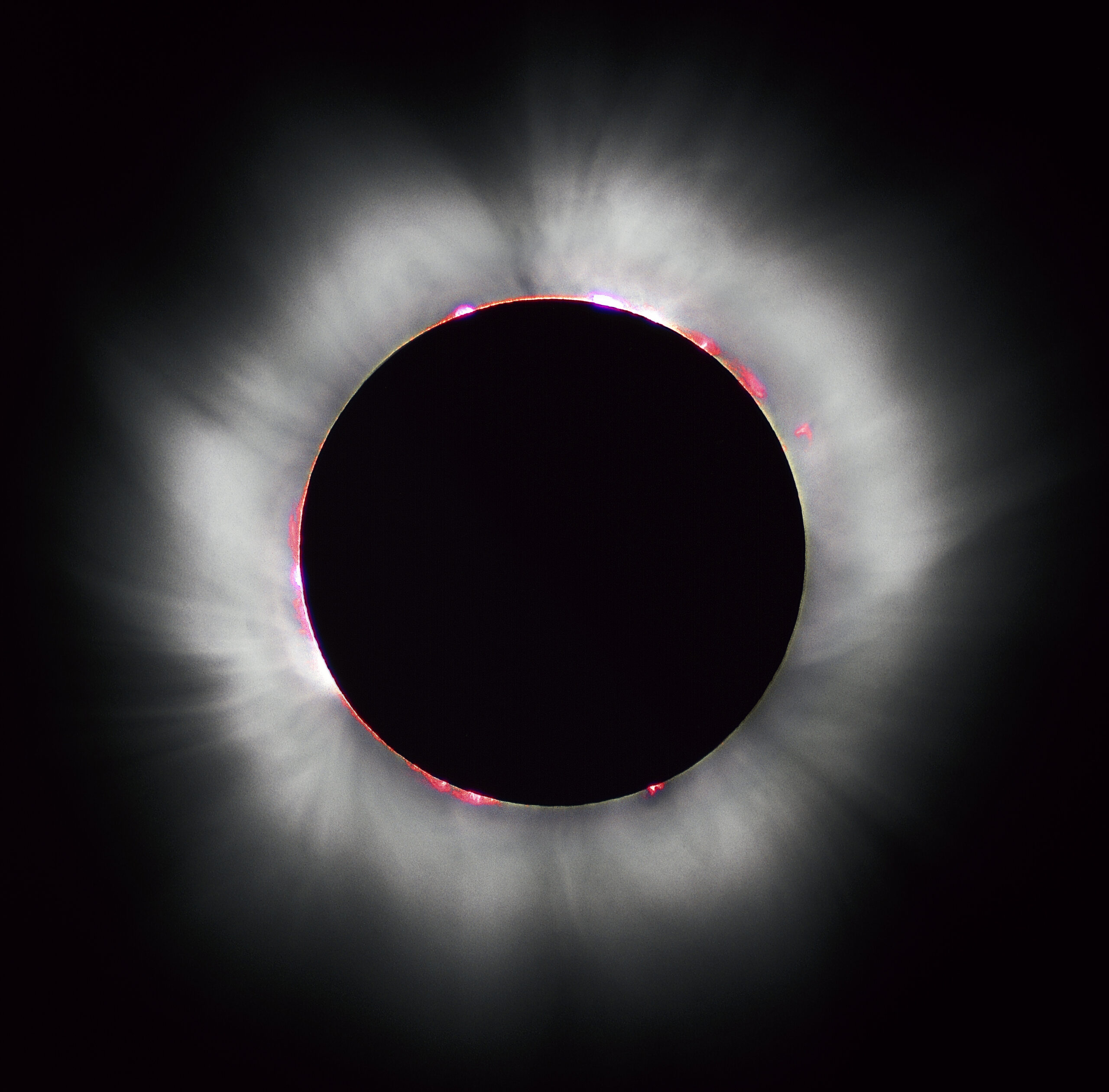
Today, 12 August, a total solar eclipse crosses Greenland, Iceland, Portugal and northern Spain. For anyone standing inside a narrow band of shadow, the Sun will disappear entirely for a couple of minutes in the middle of the day.
Here is what is happening, and — this part matters — how to look at it without damaging your eyes.
Advertisement — ad space reserved
A coincidence of size and distance
The Sun is about 400 times wider than the Moon. It is also about 400 times further away. That coincidence — and it is a coincidence — means the two appear almost exactly the same size in our sky.
It is the reason total eclipses look the way they do. The Moon covers the Sun’s blinding disc almost precisely, leaving the corona visible: the faint outer atmosphere that is normally lost in glare.
This will not always be true. The Moon is drifting away from Earth by a few centimetres a year, and in the distant future it will appear too small to cover the Sun completely. Total eclipses are a feature of this particular era.
Why eclipses are not monthly
The Moon passes between Earth and Sun every month, so it is reasonable to ask why there is not an eclipse every month.
The answer is that the Moon’s orbit is tilted by about five degrees relative to Earth’s orbit around the Sun. Most months, the Moon passes above or below the Sun from our point of view, and its shadow misses Earth entirely.
Only when the alignment is close enough does the shadow fall on us. And because the Moon’s shadow is small, the region where the Sun is fully hidden — the path of totality — is a narrow band, often only around a hundred kilometres wide, sweeping across the surface.
Stand outside that band and you see a partial eclipse: a bite taken out of the Sun. It is interesting. It is not the same event.
Advertisement — ad space reserved
How to watch without hurting your eyes
This is the part to take seriously, because eye damage from eclipse viewing is painless while it is happening.
The retina has no pain receptors. Sunlight focused onto it can cause lasting damage without any sensation at the time, with the loss of vision becoming apparent hours later. That is why the standard advice is stricter than people expect.
- Ordinary sunglasses are not adequate, no matter how dark, and stacking several pairs does not help.
- Use eclipse glasses or viewers that meet the recognised international safety standard for direct solar observation, and check them for scratches or holes before use.
- Never look through binoculars, a telescope or a camera lens while wearing eclipse glasses. The optics concentrate the light and can burn through the filter almost instantly.
- Supervise children closely throughout.
A pinhole projector is the simplest safe method and requires nothing but card. Make a small hole in one piece, hold it up, and let the image of the Sun fall onto a second piece held below. You watch the projected image, never the Sun.
During totality itself — and only during the brief period when the Sun’s disc is completely covered, and only if you are inside the path — the corona can be viewed directly. The moment the first sliver of Sun reappears, protection goes back on. If there is any doubt about whether totality has ended, use the filter.
What people notice
Accounts of totality are consistent across cultures and centuries. The temperature drops noticeably. Birds go quiet and some settle as if for evening. The light turns strange in the minutes beforehand — not dimmer exactly, but thinner, with unusually sharp shadows.
Then the shadow arrives, often visibly, racing across the landscape, and the corona appears around a black disc where the Sun was.
Why it still matters scientifically
Eclipses were historically how the corona was studied at all, and the 1919 eclipse provided the observation that supported Einstein’s general theory of relativity by showing starlight bending around the Sun.
Space-based instruments now do much of this work continuously. But eclipses remain useful for observing the inner corona, and they retain a value that is harder to quantify: they are the one astronomical event that reliably makes large numbers of people stop and look up.
Eclipse date and path as listed by Encyclopaedia Britannica’s 2026 events calendar. Eye-safety guidance follows standard advice from astronomical and optometric bodies; if you have any concern about your eyes, consult an optometrist or doctor.
Advertisement — ad space reserved
Leave a Reply