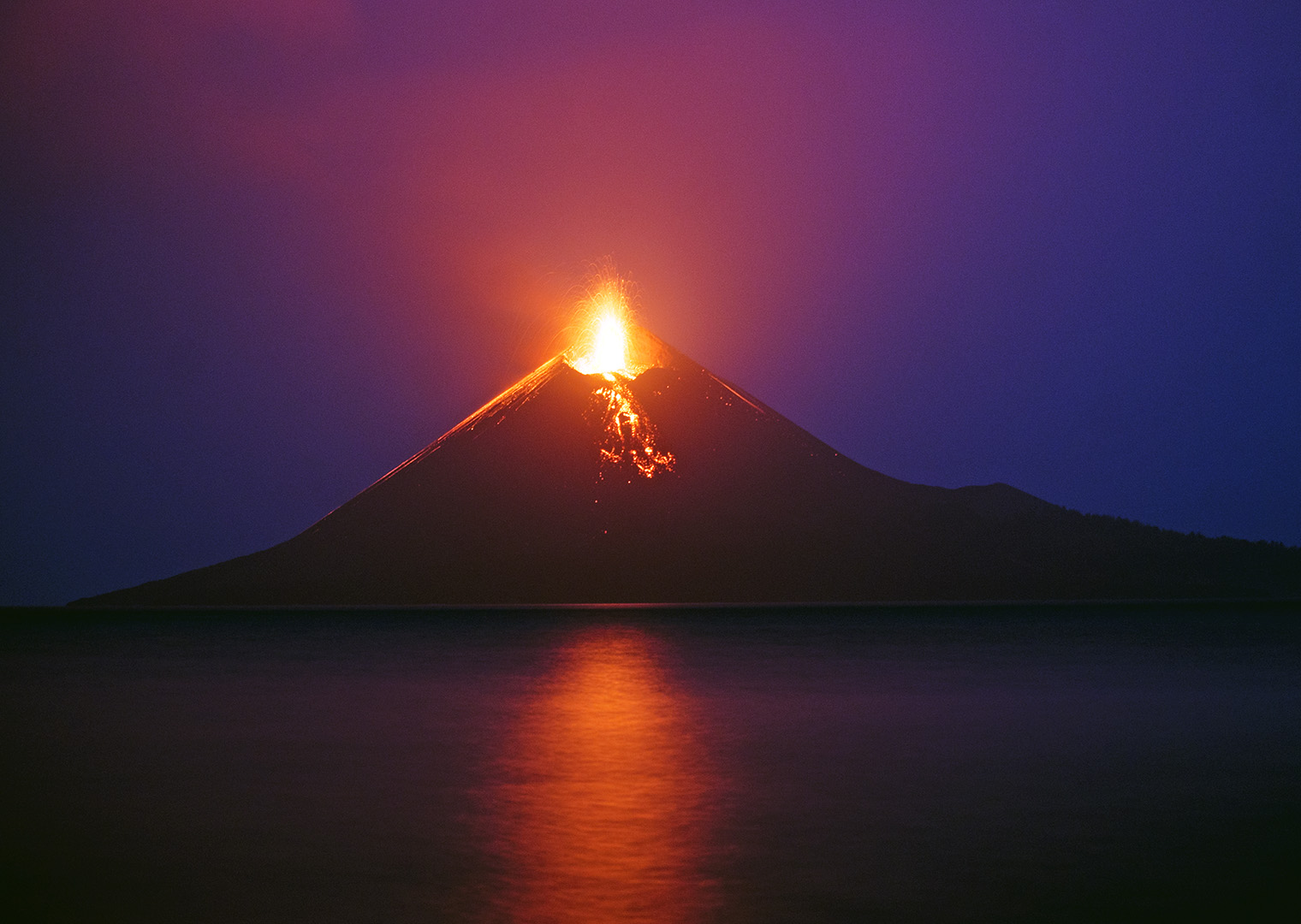
Ash from Anak Krakatau, the volcano in Indonesia’s Sunda Strait, has disrupted air travel across the region, with reporting indicating well over a thousand flights affected and hundreds of thousands of passengers delayed or rerouted.
Volcanic ash is one of the few natural phenomena that can close airspace outright, and the reason is not obvious from the name. This is not smoke or soot.
Advertisement — ad space reserved
Why ash and jet engines cannot coexist
Volcanic ash is pulverised rock and glass. The particles are abrasive, and critically they melt at temperatures below those inside a running jet engine.
Ash drawn into an engine melts in the combustion section, then resolidifies on the cooler turbine components downstream. The deposits build up on surfaces designed to very fine tolerances, restrict airflow and can cause the engine to lose thrust or shut down entirely. Ash also sandblasts windscreens until they are difficult to see through, and can block the small external ports that supply airspeed and altitude instruments.
The most cited illustration remains a 1982 British Airways flight over Indonesia that lost all four engines after flying into an ash cloud from Mount Galunggung. The crew restarted the engines during the descent and landed safely. The incident is why the international system of Volcanic Ash Advisory Centres exists.
Why it cannot simply be flown around
Ash is close to invisible. Weather radar detects water droplets, and ash clouds contain little water, so they do not reliably appear on the equipment aircraft carry. Pilots may not see one until they are inside it, particularly at night.
Forecasting depends on satellite imagery combined with atmospheric dispersion models, which project where ash will travel given wind at different altitudes. These models have uncertainty, and the uncertainty compounds with time. This is why advisories are issued in bands rather than precise boundaries, and why airspace closures often look excessive relative to where ash is later shown to have been.
The Sunda Strait’s position makes the disruption particularly costly. It sits on routes between Jakarta and much of the region, so a closure there does not simply divert traffic. It removes capacity from a busy corridor, and the delays propagate through schedules for days as aircraft and crews end up in the wrong places.
Advertisement — ad space reserved
The disagreement over how cautious to be
Aviation authorities historically applied a zero-tolerance rule: any detectable ash meant no flying. That approach was tested during the 2010 Eyjafjallajökull eruption in Iceland, which closed much of European airspace for days at very large economic cost.
Afterwards, regulators and manufacturers moved toward concentration thresholds — permitting operations in low ash densities and requiring additional inspections. Airlines argued the blanket approach was disproportionate and that engines demonstrably tolerate small quantities.
The counter-argument, made by safety specialists, is that thresholds depend on measuring concentration accurately in real time, which remains difficult, and that damage is cumulative — an engine may absorb several low-level exposures with no visible symptom until a component fails later. On this view, the earlier approach was crude but erred in the right direction.
Neither side disputes the physics. They disagree about how much confidence to place in measurement, and that is a question about instruments rather than volcanoes.
What passengers should expect
Disruption of this kind resolves unevenly. Airspace can reopen quickly if wind shifts, but the backlog outlasts the closure, and passengers rebooked onto later flights compete with those already holding seats.
Anyone travelling in the region should check directly with their airline rather than relying on general news of reopening, and should be aware that compensation rules in most jurisdictions treat volcanic activity as an extraordinary circumstance, which affects what carriers owe beyond rebooking and basic care.
Advertisement — ad space reserved
Sources
- Reporting on Anak Krakatau ash and regional flight disruption, September 2026
- Indonesian volcanology agency and Volcanic Ash Advisory Centre advisories
- International Civil Aviation Organization guidance on volcanic ash and aviation safety
- Published accounts of British Airways Flight 9 (1982) and of the 2010 Eyjafjallajökull airspace closures
Leave a Reply